Right now, somewhere in your city, there is a person who has already decided to spend money on what you sell. They went somewhere else. They are not thrilled about it.
Maybe the consultation felt rushed. Maybe they were quoted a number that did not match what they were told on the phone. Maybe they were talked into a package when they came in asking about one thing. Maybe nothing went wrong at all and they just have a quiet, nagging sense that they should check one more place before they commit.
That person is the most motivated buyer in your entire market. They have already crossed the hardest threshold, which is deciding to do the thing at all. They have done the research. They have learned the vocabulary. They have the money set aside.
And almost nobody in your category is speaking to them.
The buyer everyone ignores
Look at how most practices and service businesses market themselves. Everything is built for one person: someone who has never considered this before and needs to be convinced it is a good idea.
So the website explains what the treatment is. The social media posts explain why someone might want it. The offers are built for first timers.
Meanwhile there is a second group, and in a mature market it is often larger. These are people who are already in motion. They have a quote in their email. They have a consultation on the calendar. They have a number in their head and a small amount of doubt they have not told anyone about.
Nobody is talking to them, because talking to them feels uncomfortable. It sounds like poaching. It sounds like you are calling someone else bad at their job. So the whole category politely leaves that buyer alone with a browser tab and a credit card.
In my experience, the awkwardness is the opportunity. Positions that feel slightly uncomfortable to claim are almost always the ones nobody has claimed yet.
Why this works, and it has nothing to do with competition
I spent years rolling out healthcare technology into hospitals, which means I spent years walking into rooms where people had already been through a bad implementation. Those were the hardest audiences and also the most winnable ones.
Here is what I learned. A person who has had a disappointing experience is not closed off. They are hyper alert. They are looking for specific evidence that this time will be different, and they will notice things a first timer never would: whether you answer the question they asked, whether you admit what you do not know, whether you try to close them in the first ten minutes.
Do those three things well and you do not have to sell at all. The comparison does the selling for you.
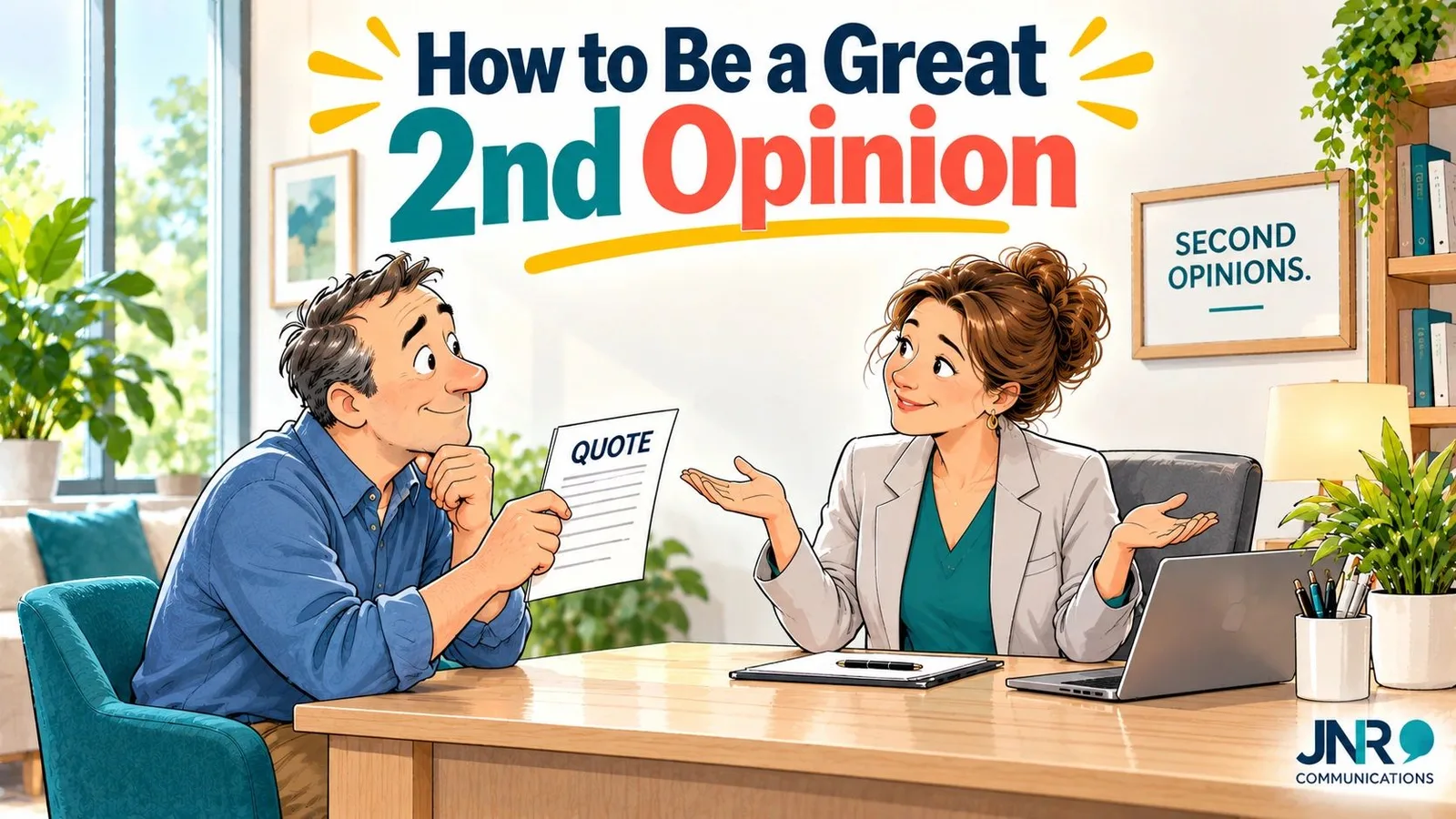
That is the mechanism behind the second opinion. You are not asking anyone to trust you more than the last place. You are asking for one low risk conversation, and then you behave differently for forty five minutes.
The offer, in plain language
A second opinion is not a discount and it is not a sales appointment with a friendlier name. If you build it like a sales appointment, buyers will smell it immediately, because they have just come from one.
Here is what it needs.
A defined promise. Say exactly what the visit includes and what it does not. For example: a full assessment, a written summary of what we would recommend and what we would not, and a price you can take with you. No treatment performed that day, no pressure, no obligation.
A time limit and a real name. "Second Opinion Consultation, 45 minutes, with a provider." Vagueness reads as a trap. Specifics read as a process, and a process is what a nervous buyer is hoping to find.
Permission to leave. The single most persuasive sentence available to you is some version of: "If what you were told elsewhere is right for you, I will tell you that, and you should go do it." Nobody says this. That is exactly why it lands.
One honest boundary. Decide in advance what you will not do. Most of our clients in aesthetics and dermatology will not evaluate work that is still healing, and they will not offer an opinion on a complication that belongs back with the original provider. Publish that. A stated limit makes everything else you say more believable.
How to talk about the other provider
This is where second opinion programs go wrong, so let us be specific.
You never need to criticize anyone to win this conversation. Not once. The moment you do, the buyer learns something about you that they did not want to know, which is that you are willing to talk about a client behind their back.
Train your team on the pivot. When a patient says "the last place told me I needed four sessions," the answer is not "that is ridiculous." The answer is: "Here is how I arrived at my recommendation, and here is what I looked at to get there. Different providers weigh these things differently."
You are not defending or attacking anyone. You are showing your reasoning. Showing your reasoning is the entire product.
And sometimes you will look at a chart and conclude the first provider was right. Say so, warmly and clearly. You just lost a sale and gained something considerably more valuable, which is a person who will tell that story to everyone they know. That is Givers Gain working on a fifteen minute timeline.
The intake question that changes everything
Add one question to your intake form and your call script: "Have you consulted anywhere else about this, and what did you think?"
Two sentences of answer will tell your provider more than the rest of the form combined. It surfaces the real fear, the real budget, and the real objection before anyone walks into the room. It also tells you, over a few months, exactly which competitors are sending you their unhappy buyers and why. That is market research you cannot purchase.
Tell your referral partners, because they are already handling these people
Here is the part most businesses miss.
Your referral partners get asked about this constantly. The hairstylist whose client is nervous about a quote. The primary care physician whose patient is unsure about a specialist's recommendation. The general contractor whose customer got one estimate and does not know if it is fair. Every one of them wants to be helpful and does not want to be responsible for sending someone into a hard sell.
Give them an easy thing to say: "I know a place that will give you a straight second opinion and will not pressure you."
That sentence is repeatable, it makes your partner look generous, and it costs them no risk at all. In my years in referral rooms, the businesses that get talked about most are not the ones with the best pitch. They are the ones whose value is easy to say out loud in one sentence.
What you can do this week
- Write the offer. One paragraph. What the visit includes, how long it takes, what it costs or that it is complimentary, and the sentence that gives the buyer permission to walk away.
- Add the intake question to your form and your phone script, and tell your front desk why it matters.
- Tell five referral partners, in person or by text, that this is something you do now. Give them the one sentence to repeat.
- Put it on the service pages where the expensive decisions live, not on a page nobody visits.
Do all four and you have built a positioning nobody in your market owns, using no new equipment, no new services, and no budget. Just a page, a question, and the nerve to tell a stranger that the other guy might be right.
The most motivated buyer in your market is already shopping. The only question is whether your name comes up while they are still deciding.
Building genuine connections takes time, but it is the foundation of PR that actually works. At JNR Communications, we combine Jennifer's nearly 30 years of media relationships with my strategic networking expertise to help businesses in beauty, wellness, and medical aesthetics achieve visibility that generates real results. Let's talk about your goals.
Greg@JNRcommunications.com | JNRcommunications.com