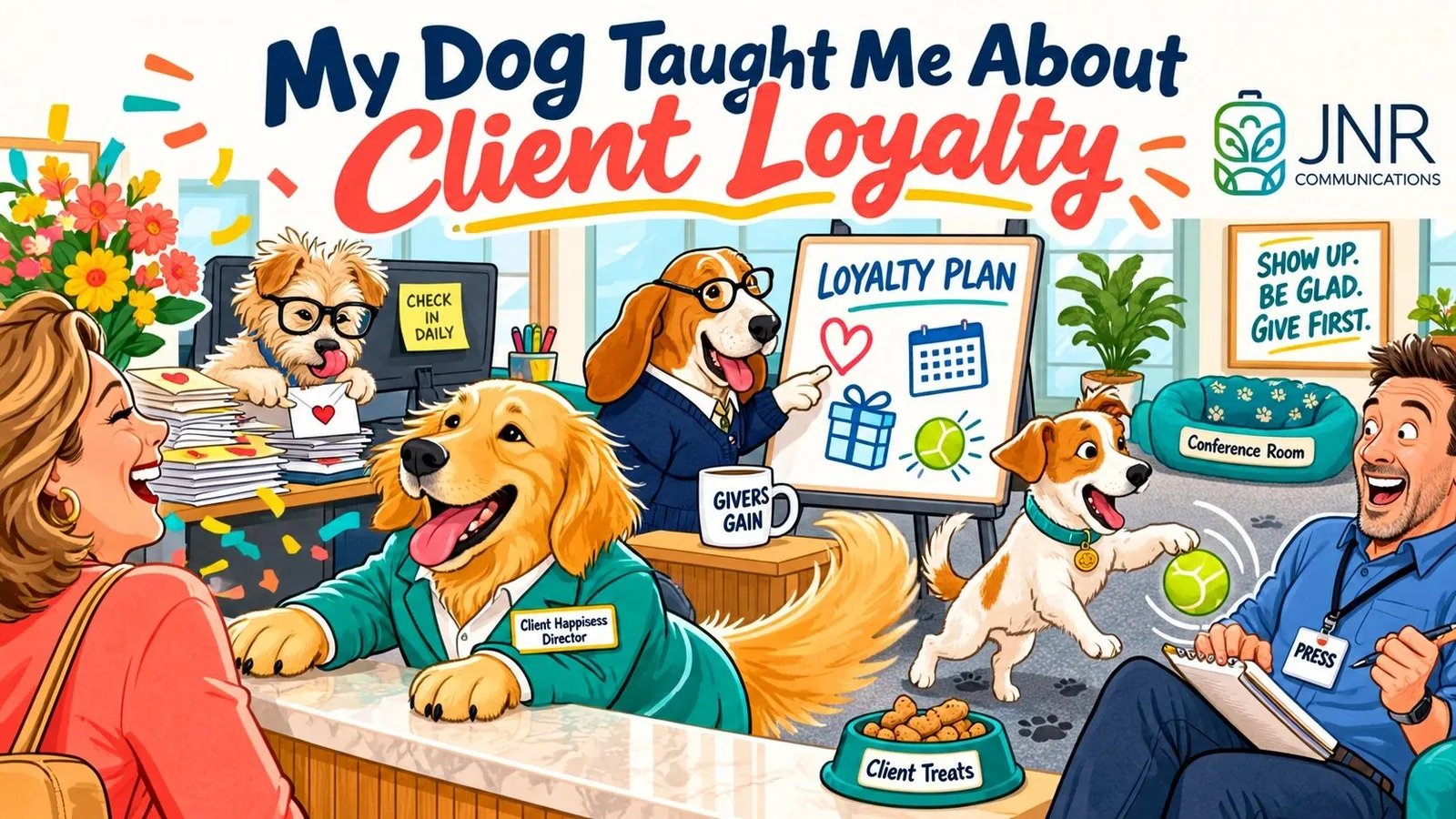
Every morning at roughly 6:00 a.m., I receive the most enthusiastic customer welcome in the state of Nevada.
It does not come from a hotel concierge or a five-star restaurant. It comes from the four dogs who share our Las Vegas home. I walk into the kitchen, and you would think I had just returned from a decade at sea. Tails spinning like helicopter blades. Paws on my knees. One of them always brings me a gift, usually a tennis ball with a texture I prefer not to describe.
I have spent decades studying how relationships work. I studied socio-cultural dynamics as a scholar in Japan. I designed training programs that helped hospitals trust new healthcare technology. I have sat through more networking breakfasts than any human should.
And yet some of the best lessons I have ever learned about client loyalty came from creatures who drink out of the toilet lol.
Let me explain.
Lesson 1: Show Up Every Single Day
My dogs have never once taken a day off from loving me. Not on weekends. Not on holidays. Not on the day I accidentally stepped on a tail at 2:00 a.m. Consistency is their entire business model, and it works.
Most businesses, on the other hand, show up for clients the way some people show up for the gym: enthusiastically in January, mysteriously absent by March. They are attentive during the sales process, available while the invoice is fresh, and then they vanish until it is time to renew.
In my experience, loyalty is not built during the big moments. It is built in the boring ones. The quick check-in email. The congratulations note when a client lands an award. The article you forward because it made you think of them.
Your clients do not need you to be spectacular. They need you to be reliable.
A dog never wonders if it should check in today. It just does. Your clients notice the businesses that behave the same way.
Lesson 2: Be Genuinely Happy to See People
Here is something every dog understands that many businesses have forgotten: people can tell when you are actually glad they are there.
Nobody has ever walked through their front door and wondered whether their dog was faking it. That joy is real, and it is irresistible.
Now think about the last time you walked into a medical spa, a dermatology office, or a boutique. Did the person at the front desk look up and smile like you made their day? Or did they keep typing while you stood there holding your car keys like an awkward statue?
For the medical aesthetics and wellness practices we work with at JNR Communications, the first thirty seconds of a patient visit often matter more than the most expensive marketing campaign. Warmth is not a soft skill. It is a retention strategy.
So greet people like they matter. Use their names. Remember their kids, their trips, their milestones. You do not need to jump on anyone's lap. Please do not jump on anyone's lap. But you can make every person feel like the highlight of your day.
Lesson 3: Give Before You Ask
To be fair, my dogs ask for treats constantly. They have no shame about it, and I do not recommend copying this particular behavior. But they also give first. They offer comfort before they have any idea whether a snack is coming. They bring the tennis ball. They sit beside you when you are having a rough day. They invest in the relationship long before they collect.
This is the heart of the Givers Gain philosophy that has shaped how I approach networking. When you lead with generosity, by making introductions, sharing ideas, or celebrating someone else's win, people remember. And when they need a trusted partner, they think of you first.
The businesses that struggle with loyalty usually have this backwards. Every interaction is an ask. Every email is a pitch. Every social post is a coupon.
Give first. The treats will come.
Lesson 4: Read the Room
Dogs are masters of nonverbal communication. They know when you are excited, when you are stressed, and when you need them to stop barking at the mail carrier and just lie quietly by your feet.
When I lived in Japan, I learned a phrase that captures this beautifully: kuuki wo yomu, which means "reading the air." It describes the ability to sense what a situation needs without anyone saying it out loud. In Japanese business culture, it is considered an essential relationship skill.
Dogs read the air better than most executives I have met.
For your business, this means paying attention to the signals clients send. Are their replies getting shorter? Did they skip the last two check-ins? Did they sound rushed on your last call? Those are the moments to reach out with a simple question: "How are things really going?"
The client who feels understood is the client who stays.
Lesson 5: Forgive Quickly and Recover Faster
I once came home three hours late after a meeting ran long. Dinner was delayed. Walks were postponed. By any measure, I had failed to deliver on our service agreement.
My dogs greeted me as if I were a hero returning from war.
Now, I am not suggesting your clients should forgive you that easily. They should not, and most will not. But the dog teaches us something about the other side of the relationship: grudges are expensive, and recovery is everything.
When something goes wrong with a client, and eventually something will, the fastest path back is the dog's path. Show up. Acknowledge it openly. Make it right quickly. Do not get defensive, and do not disappear.
In my years training healthcare teams on new technology, I saw again and again that trust was not destroyed by mistakes. It was destroyed by how people handled them. The trainer who said "I got that wrong, here is the fix" earned more loyalty than the one who never seemed to make mistakes at all.
Where the Dog Analogy Breaks Down
In the interest of responsible business advice, I must add a few important exceptions.
Do not sniff your clients. Do not bark at your competitors, even if they deserve it. Do not chase cars, squirrels, or every shiny new marketing trend that runs across your path. And please, under no circumstances, roll in something unpleasant right before an important meeting.
Some lessons are best left in the backyard.
What Dogs Teach Us About PR
Here is where this gets practical for anyone thinking about public relations.
Journalists, producers, and editors are loyal to the same things clients are loyal to. They trust sources who show up consistently, who bring genuine value, who understand what they need without being told twice, and who handle the occasional misstep with grace.
That is why my partner Jennifer Rice's nearly 30 years of media relationships matter so much to our clients. Those relationships were not built through a blast of press releases. They were built through years of showing up, giving first, and being someone reporters were genuinely glad to hear from.
This matters even more right now. Reporters' inboxes are flooded with AI-generated pitches that all sound alike, polished and eager and completely forgettable. In that sea of noise, the familiar voice of someone a journalist already trusts stands out like a golden retriever at a cat show. Machines can write a thousand pitches an hour. They cannot build a relationship.
That is relationship infrastructure. And whether you are earning loyalty from a client, a patient, or a journalist, it works the same way.
Your Dog-Approved Loyalty Plan
Here are five things you can do this week:
- Schedule a non-sales check-in with your top five clients. No pitch, no agenda, just genuine interest.
- Audit your first impression. Walk through your front door, website, or phone line as if you were a new client. Would you feel welcomed?
- Give one thing away. Make an introduction, share a resource, or publicly celebrate a client's win.
- Watch for quiet signals. Note any client who has gone silent and reach out personally.
- Own one mistake fast. If something slipped recently, address it directly before it grows.
My dogs have never read a business book. They have never attended a networking event or posted on LinkedIn. And they are still the most loyal relationship builders I know.
Maybe it is time we all took a page from their playbook. Just skip the part about the toilet.