
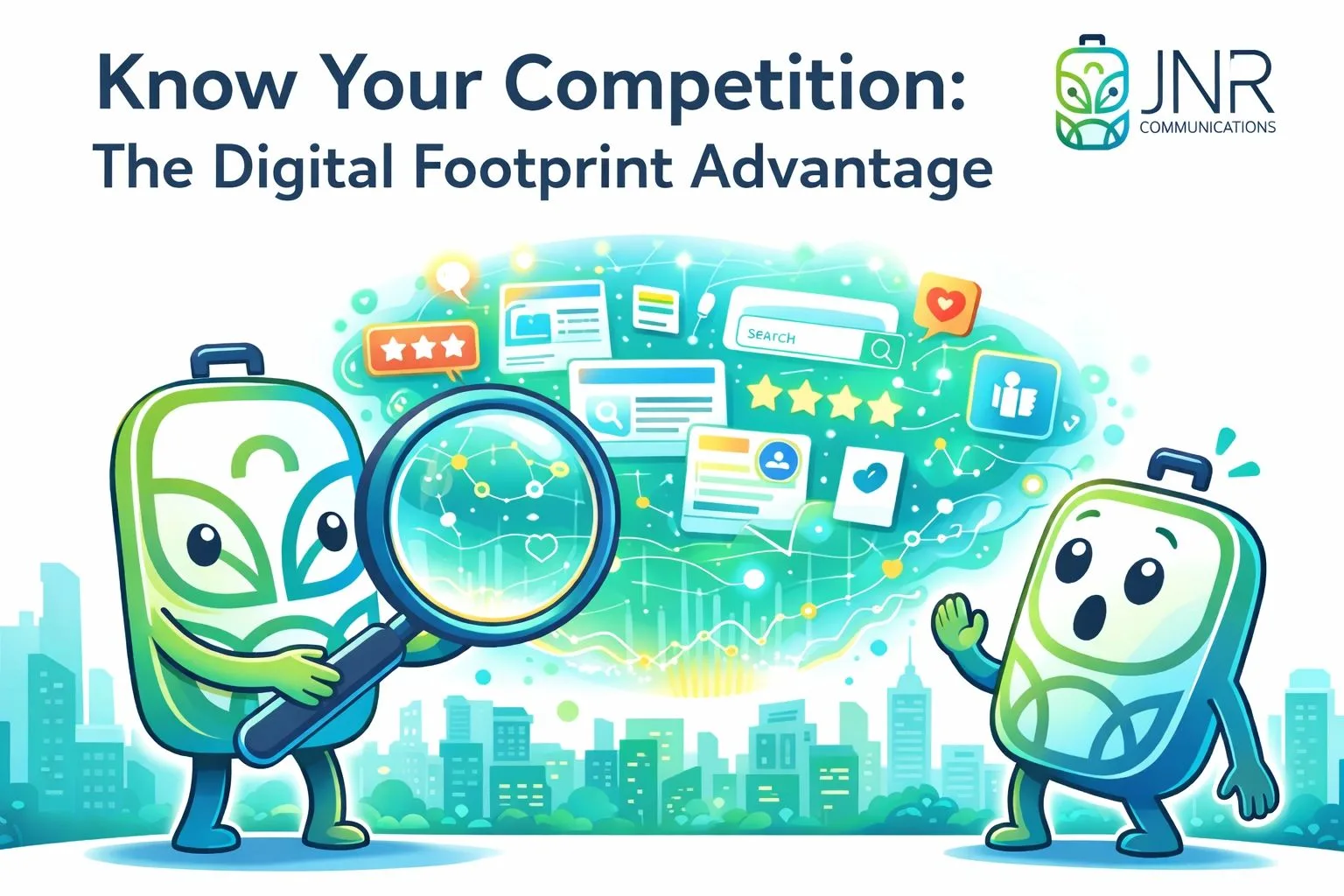
There is a question I ask almost every new client we work with at JNR Communications, and it almost always catches them off guard: "How well do you really know your competition's digital presence?"
Most business owners can name their top competitors without hesitation. But when I press deeper and ask what those competitors are publishing, where they are getting media coverage, how their social media engagement compares, and what keywords they are ranking for, the room gets a lot quieter.
That silence is, in itself, a business problem.
My years in healthcare technology, international business development, and strategic communications have taught me that the businesses that grow consistently are the ones that understand not just where they stand, but where they stand relative to everyone else in the conversation. In PR and digital marketing, that conversation is happening online, every single day, whether you are participating in it or not.
A competitor analysis of your digital footprint is not about imitation. It is about intelligence. It is about understanding the landscape so you can navigate it with precision rather than guesswork. And it is one of the most valuable things we do for our clients at JNR Communications.
What Exactly Is a Digital Footprint in PR Terms?
When I talk about a digital footprint in the context of public relations and communications, I am referring to the entire web of digital presence a brand has built over time. This includes:
• Media coverage: earned press mentions, features, and interviews in publications relevant to your industry
• Social media presence: the platforms they are active on, posting frequency, engagement rates, and audience size
• Content strategy: the blog topics they cover, how often they publish, the depth and quality of their content
• Search visibility: the keywords they rank for, their domain authority, and their overall SEO positioning
• Review and reputation signals: how clients and customers talk about them on public platforms
• Awards and recognition: industry accolades, certifications, and third-party validations they have earned
Together, these elements paint a remarkably detailed picture of how a competitor is positioning themselves in the market, what narratives they are building, and where the gaps and opportunities exist for your brand to differentiate and stand out.
"The goal of a competitor analysis is not to copy what is working for someone else. It is to understand the terrain well enough to chart a smarter course for your own brand."
Why Most Businesses Skip This Step (And Pay the Price)
I understand why competitor analysis often gets pushed to the back burner. Running a business demands constant attention, and it is easy to stay heads-down on your own execution without lifting your gaze to see what is happening around you.
But in my experience, the businesses that skip this step consistently make the same expensive mistakes. They invest heavily in content strategies their competitors have already proven ineffective. They pitch media outlets that are already saturated with similar voices. They ignore platforms where their competitors have quietly built significant audiences. And they miss the white space, those underserved topics and channels where a thoughtful, well-timed entry could generate outsized visibility.
I think of it like the Japanese concept of nemawashi, which I was introduced to during my time as a Ministry of Education Scholar at Nagoya University. Nemawashi refers to the process of laying the groundwork carefully and methodically before making a major move. You consult, you observe, you prepare. You do not leap before you understand what you are leaping into.
A competitor digital footprint analysis is your nemawashi for PR strategy. It is the preparation that makes everything that follows more deliberate, more targeted, and ultimately more effective.
What a Thorough Competitor Analysis Actually Reveals
When we conduct a competitor digital footprint analysis at JNR Communications, we are looking for specific, actionable intelligence across several dimensions.
Media Coverage Patterns
We examine which publications are covering your competitors, how frequently, and for what kinds of stories. Are they being featured in trade publications? Consumer lifestyle media? Local business press? Understanding these patterns helps us identify both the outlets where your brand should be building relationships and the story angles that are getting traction in your space.
Jennifer Rice's nearly 30 years of media relationships, including deep connections with major publications. It gives us a significant advantage here. We are not just reading coverage from the outside. We understand what editors in your space are looking for, and we use competitor coverage patterns to identify where the conversation is already heading.
Social Media Strategy and Engagement
We analyze your competitors' social media presence not just for follower counts, which are a vanity metric, but for actual engagement. What content formats are generating the most interaction? What topics are sparking conversation? Are they leaning into video, long-form posts, or quick educational graphics? This intelligence directly informs our social content recommendations for your brand.
Content Gaps and Opportunities
This is often where we find the most immediately actionable insights. When we map out what your competitors are writing about, we inevitably find topics that are underserved or entirely absent. These are opportunities for your brand to own a part of the conversation that no one else has claimed yet. In my experience, some of the highest-performing content we have helped clients create came directly from gaps identified in competitor analysis.
Search Visibility and Keyword Positioning
Understanding which keywords your competitors rank for and which ones they are ignoring shapes a smarter SEO content strategy. Rather than fighting uphill battles for terms where competitors have an entrenched advantage, we help clients identify accessible, high-value keywords where their content can gain traction more quickly.
How JNR Communications Uses This Intelligence
At JNR, competitor analysis is not a one-time exercise we run at the start of an engagement and then file away. It is an ongoing practice woven into how we develop and refine strategy for every client.
Here is what that looks like in practice.
When we onboard a new client, we begin with a comprehensive audit comparing their current digital footprint against their top three to five competitors across all of the dimensions I described above. This baseline audit gives us a clear picture of where the client stands today, where competitors have built advantages, and where the most accessible opportunities exist.
From there, we build a PR and content strategy that is grounded in competitive reality rather than aspirational assumptions. If a competitor has been publishing consistently on a particular topic and has built real SEO authority around it, we do not simply copy that approach. We find the adjacent angle, the nuance they missed, the specific audience segment they are not speaking to directly. That is where differentiated positioning lives.
We also use ongoing competitive monitoring to keep our clients ahead of shifts in the landscape. When a competitor lands a major media placement, we analyze why and what that tells us about editorial appetite in the market. When a competitor's social media strategy pivots, we pay attention. This continuous intelligence loop is part of what we mean by relationship infrastructure: not just building your own connections, but understanding the entire web of relationships in your industry so you can navigate it more strategically.
"Understanding your competitors' digital footprint is not about chasing what they are doing. It is about being smart enough to see where they have left the door open for you."
What This Means for Your Brand Right Now
If you have never done a formal competitor digital footprint analysis, or if the last one you did was more than six months ago, you are likely making strategic decisions based on incomplete information.
Here are three things you can do right now to start building competitive clarity:
• Google your top three competitors. Go beyond the first page. Note what kinds of content are appearing, which publications are covering them, and what story narratives seem to be sticking.
• Visit their social media profiles. Look not at follower counts but at which posts are generating real engagement. Comments and shares are the signals that matter most.
• Read their most recent press coverage. Look for the story angles, the publication types, and the spokespeople they are positioning. Then ask yourself honestly where the gaps are that your brand could fill.
These basic steps will not replace a thorough analysis, but they will start to show you how much intelligence is sitting right there on the surface, waiting to inform a smarter strategy.
The Relationship Angle: Why This Matters Beyond Tactics
I want to close with a thought that goes beyond professional networking, there is a principle called Givers Gain: the idea that the more genuinely you understand and invest in the people and community around you, the more you benefit in return.
Competitor analysis, done well, embodies a version of that principle. It is an act of genuine attention to the world your brand operates in. It requires you to look beyond your own walls and understand the broader ecosystem of voices, relationships, and narratives that shape how your industry is perceived.
The brands that invest in that understanding are the ones that build PR strategies that feel relevant, timely, and authentic to their audience. Because they are not speaking into a vacuum. They are speaking into a conversation they have actually taken the time to understand.
That is the kind of PR we build at JNR Communications. And it always starts with knowing the landscape.
Ready to see how your digital footprint compares to your competitors? At JNR Communications, we combine Jennifer Rice's nearly 30 years of media relationships with strategic analysis to help businesses build visibility that generates real results. Let's talk about what the data reveals for your brand. Greg@JNRcommunications.com | JNRcommunications.com