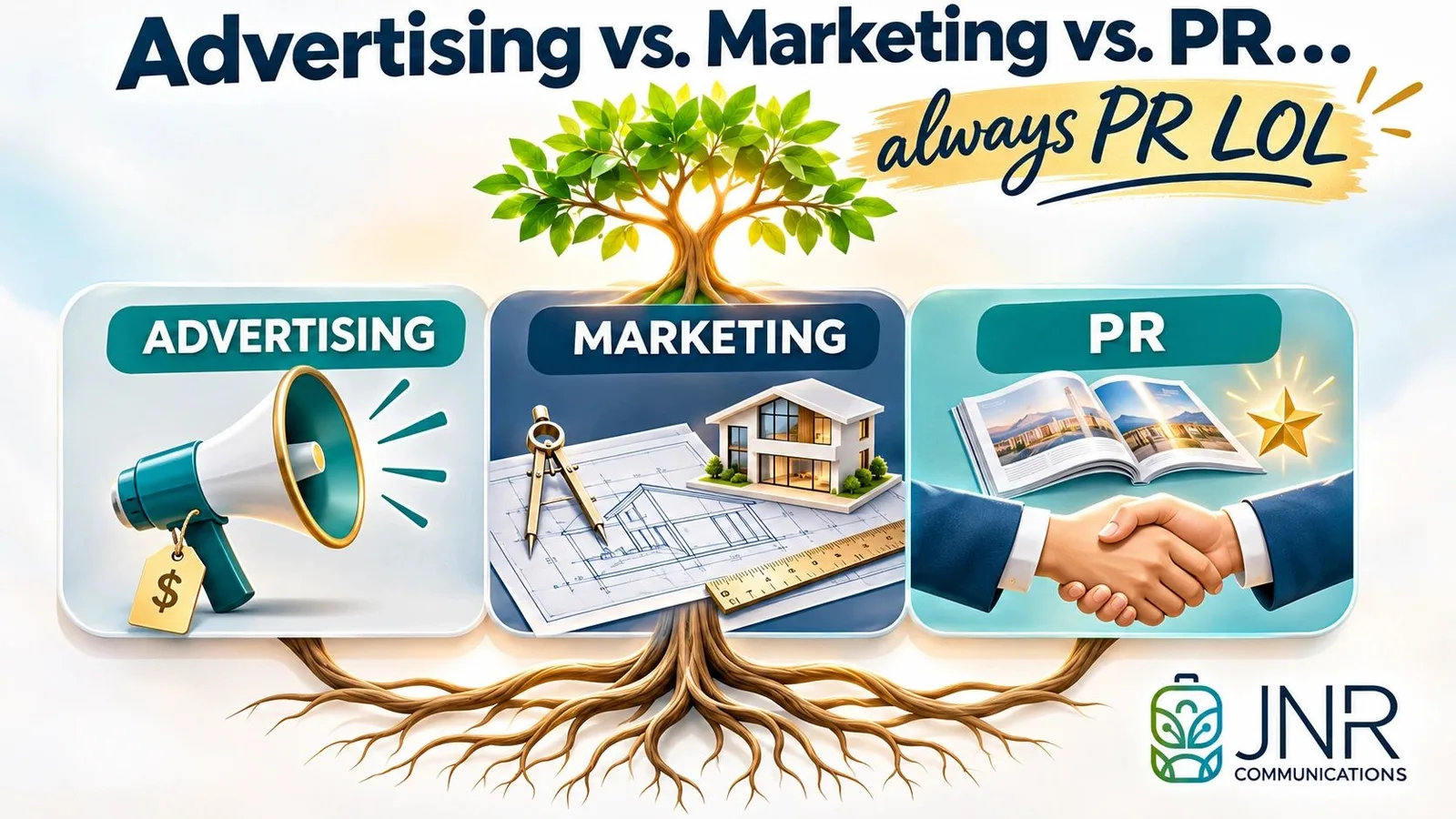

When I sit down with a new client, one of the first conversations we have is about confusion. Not theirs alone. The whole industry has muddied the waters between marketing, advertising, and public relations, and that confusion creates real problems. It leads to budget battles between internal teams. It leads to duplicated effort. It leads to leadership thinking they have to pick one discipline over the others.
So let me clear it up the way I explain it to clients. Then I want to walk through why these three disciplines are most powerful when they work in concert. And finally, I want to address something that comes up often: whether bringing in an outside PR partner is a threat to the internal team you already have. Spoiler, it is not. But the reason why matters.
Marketing Is the Strategic Umbrella
Marketing is the broad strategic function that defines who you serve, what you offer, what makes you different, how you price it, and how you reach the people most likely to buy. Everything else sits underneath marketing.
Your brand identity, your messaging architecture, your customer personas, your sales funnel, your content calendar, your email nurture sequences, your website, your SEO strategy, your conversion tracking. All marketing.
Marketing answers the foundational questions. Who are we? Who do we serve? Why us? What does the journey from stranger to customer actually look like? Without a clear marketing strategy, every other tactic becomes random motion in search of a plan.
Advertising Is Paid, Controlled Reach
Advertising is a subset of marketing. It is the practice of buying placement so your exact message reaches a defined audience on your schedule, with the precise words and images you choose.
Google Ads. Meta and Instagram campaigns. LinkedIn sponsored content. Trade publication print ads. Sponsored podcast spots. Out-of-home billboards. Programmatic display. All advertising.
The defining characteristic of advertising is control. You pay, you place, you say exactly what you want, when you want, to the audience you select. The trade-off is that audiences know it is paid. Most people are skeptical of advertising by default. They scroll past it, they install blockers, they tune it out. Advertising still works, especially for direct response and broad awareness, but you are renting attention, not earning it.
PR Is Earned Credibility
Public relations is also a subset of marketing, but it operates by an entirely different mechanism. PR earns coverage rather than buying it. A journalist, an editor, a podcast host, an awards committee, or a third party with their own audience decides your story is worth telling. That third-party endorsement carries weight that paid placement simply cannot replicate.
When New Beauty Magazine covers a client of ours, that mention is not perceived as an ad. It is perceived as a recommendation from a trusted voice in the industry. That distinction is the entire point of PR.
PR is also slower, less controllable, and built on relationships rather than transactions. You cannot guarantee a placement the way you can guarantee an ad impression. What you can do is build the relationship infrastructure, the credibility, and the consistent presence that makes coverage happen over time.
Why You Need All Three Working Together
Here is where most businesses miss the bigger picture. Marketing, advertising, and PR are not competing options. They are complementary forces that solve different problems within the same customer journey.
Marketing builds the foundation. The strategy, the message, the audience understanding, the funnel.
Advertising creates predictable reach. You control when and where your message appears, and you can scale it up or down based on goals and budget.
PR builds credibility and trust. Third-party validation that makes the advertising more believable and the marketing more effective.
Think about how decisions actually get made. A potential client sees your ad on Instagram. They are mildly interested. They Google your brand. The first thing they see is a feature in Good Housekeeping, a contributed article on a trade outlet, and a podcast appearance from your founder. Now your ad is not just an ad. It is a brand they recognize as legitimate.
That is the multiplier effect. The ad alone might convert at one percent. Paired with visible PR coverage, that same ad converts at three or four percent because the trust gap is closed. The PR did not replace the advertising. It made the advertising work harder.
Run it the other way too. You secure a fantastic media placement. Without supporting marketing infrastructure, a strong website, a clear value proposition, a way to capture and nurture interest, that placement leaks visitors who showed up curious and left unconverted. Coverage without marketing infrastructure is a leaky bucket. And without advertising, you are relying entirely on organic discovery, which limits both your speed and your scale.
The three disciplines are a system. Pull one out, and the other two work harder for less return.
How JNR Addresses All Three
At JNR Communications, we think of our work as fitting inside the larger marketing system, not competing with it. Jennifer Rice leads our earned media practice and brings nearly thirty years of relationships with editors, journalists, and producers across beauty, medical aesthetics, wellness, and consumer outlets. That is the credibility engine.
I focus on social media strategy, content architecture, and the relationship infrastructure that makes earned media actually move the needle. Social platforms are where coverage gets amplified, where communities form around brands, and where prospects do their quiet due diligence before they ever reach out.
When a client comes to us with an existing internal marketing team running ads, building landing pages, and managing email, we do not replace any of that. We integrate. We coordinate with the paid media manager so press hits get amplified through targeted ads. We coordinate with the content team so the angles we are pitching to journalists align with the SEO themes the website is already targeting. We coordinate with the social manager so a media placement turns into a week of community engagement, not a one-day blip.
PR Is Not a Threat to Your Internal Team
This is worth saying directly, because it comes up often. When leadership starts exploring outside PR support, internal marketing managers sometimes worry about turf. Will this make me look replaceable? Will my budget shrink? Will I lose control of the brand voice?
Those concerns are reasonable. They are also misplaced when the partnership is structured correctly.
A good PR agency does not duplicate what an internal team does. We do something different. The internal team owns the daily execution. The website, the funnel, the ads, the content calendar, the email program, the sales enablement. We provide the relationships, the media expertise, and the third-party validation that the internal team genuinely cannot build from scratch in the short term.
Earned media relationships take years to develop. Trade press editors have favorites they trust. Beauty editors take pitches from publicists they have known for a decade. That is not something an internal hire builds in six months. It is something an established agency brings on day one.
The internal team gets to focus on what they do best, ship more, and report better results. Coverage we secure becomes content they amplify. Awards we help win become trust signals their landing pages convert against. The agency makes the internal team look better, not redundant.
When I have seen this partnership go wrong, it is almost always because expectations were not clear at the start. When everyone agrees on roles, who owns what, who decides what, who reports what, the system works. Internal team and external agency, pulling in the same direction.
What This Means for Your Business
If you are evaluating whether to invest in marketing, advertising, or PR, the answer is rarely one of the three. The answer is the right balance of all three for your stage, your goals, and your category.
If you are early stage with no internal team, marketing comes first. Build the strategy and the funnel before you spend a dollar on ads or pitches.
If you have marketing in place but you are stuck at a growth ceiling, look at where the trust gap lives. If prospects are not converting, PR usually fills the gap faster than more ads will.
If you already have credibility but you need scale, advertising amplifies what PR has been quietly establishing.
We work with clients across all of these stages. The conversation always starts the same way. What does your full marketing system look like today? Where is the friction? And where will the next layer of investment unlock the most growth?
That is the conversation I would love to have with you.
Ready to align your marketing, advertising, and PR?
JNR Communications brings nearly 30 years of media relationships and strategic networking expertise to help businesses in beauty, wellness, medical aesthetics, and medical devices build the visibility that generates real results. Let's talk about your goals.
Greg@JNRcommunications.com | JNRcommunications.com