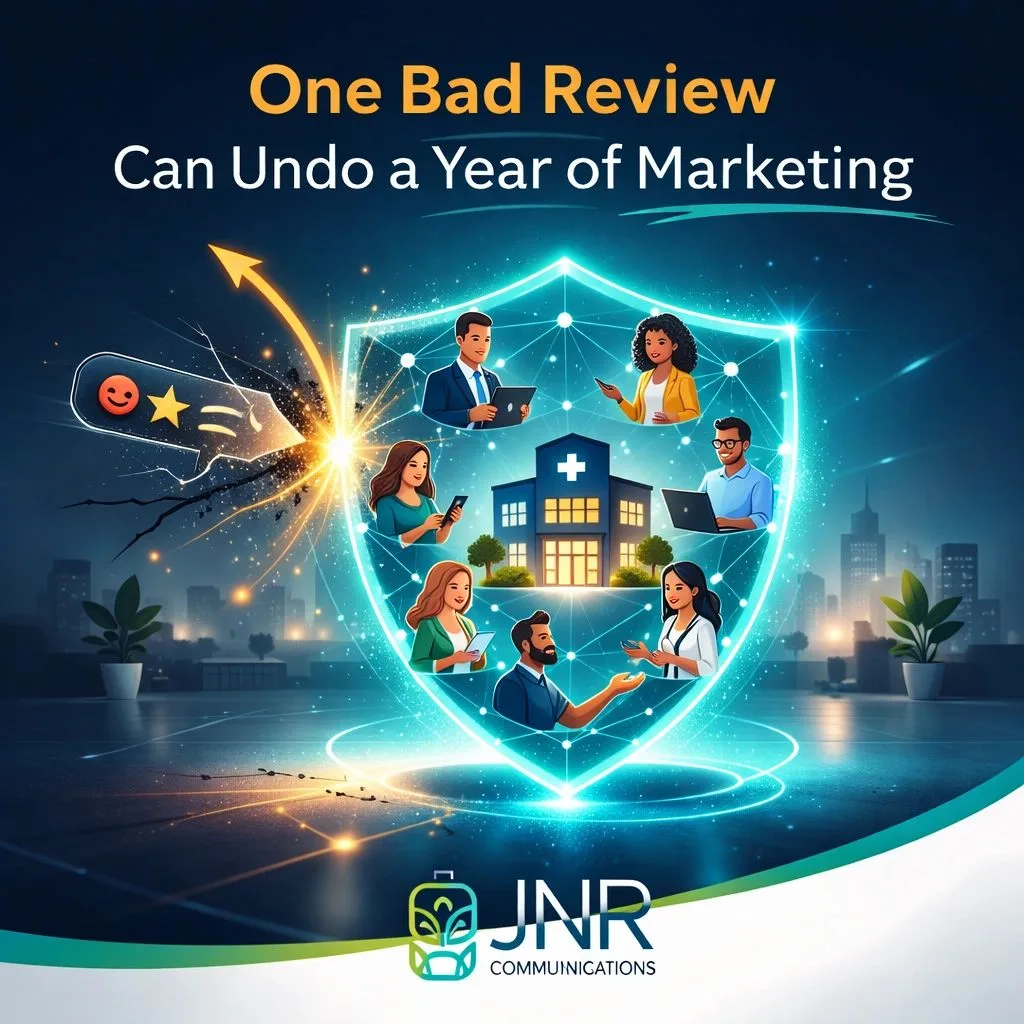
1 Bad Review Can Undo a Year of Marketing. Here's How to Build a Reputation That Can Take a Hit
I want you to imagine something for a moment. You have spent the last twelve months building your brand. You invested in professional photography. You launched a beautiful new website. You ran targeted ad campaigns. You posted consistently on social media. You even started a patient loyalty program. Everything was clicking.
Then one morning, you check Google and there it is. A one-star review. And it is not just critical. It is detailed, emotional, and persuasive. Within hours, it is the first thing potential patients see when they search your name.
Here is the hard truth that most marketing strategies ignore: all of that investment, all of those months of careful brand building, can be seriously undermined by a single negative experience made public. Not because one review is objectively more important than hundreds of positive interactions. But because reputation operates on a different set of rules than marketing.
Marketing tells people what you want them to believe. Reputation is what they actually believe. And the gap between those two things is where businesses either thrive or struggle.
Why Reputation Is More Fragile Than You Think
You already know that trust is everything. Patients are making deeply personal decisions about their appearance, health, and wellbeing. They are not choosing a restaurant for Friday night. They are choosing who to trust with their face, their body, their confidence.
That level of vulnerability means the stakes around reputation are extraordinarily high. A potential patient who reads one compelling negative review is not going to weigh it rationally against fifty positive ones. Psychologically, negative information carries more weight than positive information. Researchers call this negativity bias, and it is one of the most well-documented patterns in human decision-making.
What this means practically is that your reputation is not the average of your reviews. It is not your star rating. Your reputation is the story people tell themselves about whether they can trust you. And that story is shaped disproportionately by the negative.
So the question is not whether you will eventually face a reputation challenge. Every business does. The question is whether your reputation has the structural resilience to absorb the hit and recover.
The Problem with a Marketing-Only Approach
Here is where I see businesses make a critical mistake. They invest heavily in marketing, in ads and content and social media campaigns, but they invest almost nothing in what I call relationship infrastructure. They build a beautiful house on a foundation that cannot withstand a storm.
Marketing creates visibility. It gets your name in front of people. That matters. But visibility without depth is actually a liability when something goes wrong. If the only thing people know about your practice is what your ads told them, they have no reservoir of trust to draw from when a negative review surfaces.
Think about it from a personal perspective. If someone you barely know gets accused of something, you might believe it immediately. But if a close friend faces the same accusation, you give them the benefit of the doubt. Not because you are ignoring the accusation, but because you have a relationship that provides context.
That is exactly how reputation resilience works in business. The practices that recover quickly from negative reviews, bad press, or public complaints are not the ones with the biggest marketing budgets. They are the ones with the deepest relationships.
Relationship Infrastructure: Your Reputation's Safety Net
When I talk about relationship infrastructure, I am talking about the web of genuine connections that exists between your practice and the people who matter to your success. This includes your patients, your referral partners, the media professionals who cover your industry, your professional peers, and your local community.
When that infrastructure is strong, something remarkable happens when a crisis hits. Your community rallies. Loyal patients leave counter-reviews without being asked. Media contacts reach out to get your side of the story before publishing anything negative. Referral partners continue sending business your way because they know your character firsthand.
None of that happens by accident. It happens because you invested in those relationships before you needed them.
In my years of networking, I learned a principle from BNI that applies directly here: Givers Gain. The businesses that give generously to their communities, that build genuine relationships without always calculating the return, are the ones that receive support when they need it most. It is not a transaction. It is an ecosystem of mutual trust.
Five Strategies to Build a Reputation That Can Take a Hit
1. Invest in Media Relationships Before You Have a Story to Tell
Most businesses only reach out to journalists and editors when they want coverage. That is transactional, and journalists can feel it immediately. At JNR Communications, my partner Jennifer Rice has spent nearly 30 years building relationships with media professionals. Those relationships were not built on pitches. They were built on trust, reliability, and providing value over years of consistent engagement.
When a client faces a reputation challenge, those relationships become invaluable. A journalist who knows and trusts your PR team is far more likely to reach out for comment, present a balanced story, and give you a fair hearing than one who has never heard from you before.
2. Create an Advocacy Layer
Your most loyal customers or patients are your most powerful reputation asset, but only if you have genuinely invested in the relationship. This goes beyond loyalty programs and discount codes. It means knowing their stories, following up after procedures, celebrating their results, and treating them as partners in their own care journey.
When people feel genuinely valued, they become advocates naturally. They do not need to be asked to leave positive reviews or defend your practice online. They do it because they feel a personal connection to your success.
3. Build a Referral Network That Knows Your Character
Professional referral relationships serve a dual purpose. They generate business, and they create a network of credible voices who can speak to your professionalism and integrity. When a fellow practitioner, a wellness professional, or a complementary service provider in your network has firsthand experience with your work, their endorsement carries weight that no advertisement can match.
This is something I have seen consistently in my networking experience. The professionals who invest time in building genuine referral relationships do not just get more business. They get a support system that stands behind them when things get tough.
4. Respond to Negative Feedback as a Relationship Opportunity
This is where many businesses get it wrong. They either ignore negative reviews, respond defensively, or worse, try to have them removed. Each of those approaches signals to potential patients that you are not willing to engage in difficult conversations.
Instead, treat negative feedback as a relationship opportunity. Respond promptly, empathetically, and professionally. Acknowledge the person's experience. Offer to continue the conversation privately. Demonstrate that you care more about the person behind the review than the star rating attached to it.
Potential patients who see a thoughtful, empathetic response to criticism are often more impressed by that response than they are discouraged by the original complaint.
5. Make Community Engagement a Core Business Function
Practices that are genuinely embedded in their local communities, through sponsorships, educational events, charitable partnerships, and professional collaborations, develop a reputation that exists independently of their marketing. Community members who have experienced your generosity and engagement firsthand are not easily swayed by a single negative voice.
This is not about grand gestures. It is about consistent presence. Show up at local events. Offer educational workshops. Support causes that align with your values. Over time, this creates a depth of reputation that marketing alone simply cannot replicate.
The Long Game Is the Only Game
I will be honest with you. Building relationship infrastructure takes time. It is not as immediately gratifying as launching a new ad campaign or seeing a bump in social media followers. But the businesses that commit to this approach are the ones that are still thriving five and ten years from now.
In medical aesthetics, beauty, and wellness, where trust is the currency that matters most, your reputation is your most valuable business asset. Protecting it requires more than monitoring your Google reviews. It requires building a web of genuine relationships that provides resilience when challenges inevitably arise.
Because the question is never whether something will go wrong. The question is whether you have built a reputation strong enough to weather it.
Building genuine connections takes time, but it is the foundation of PR that actually works. At JNR Communications, we combine Jennifer's nearly 30 years of media relationships with strategic networking expertise to help businesses in beauty, wellness, and medical aesthetics build reputations that generate real results and stand strong under pressure. Let's talk about your goals.
✉️ Greg@JNRcommunications.com
About the Author
Greg Kaufman is a Partner at JNR Communications, a Las Vegas-based PR agency specializing in medical aesthetics, beauty, and wellness industries. With decades of experience in healthcare technology education, international business development, and professional networking, Greg brings a unique relationship-focused perspective to PR and social media strategy. He believes that the most effective communications begin with genuine connection and that relationship infrastructure is the foundation of sustainable business growth. Connect with Greg on LinkedIn.