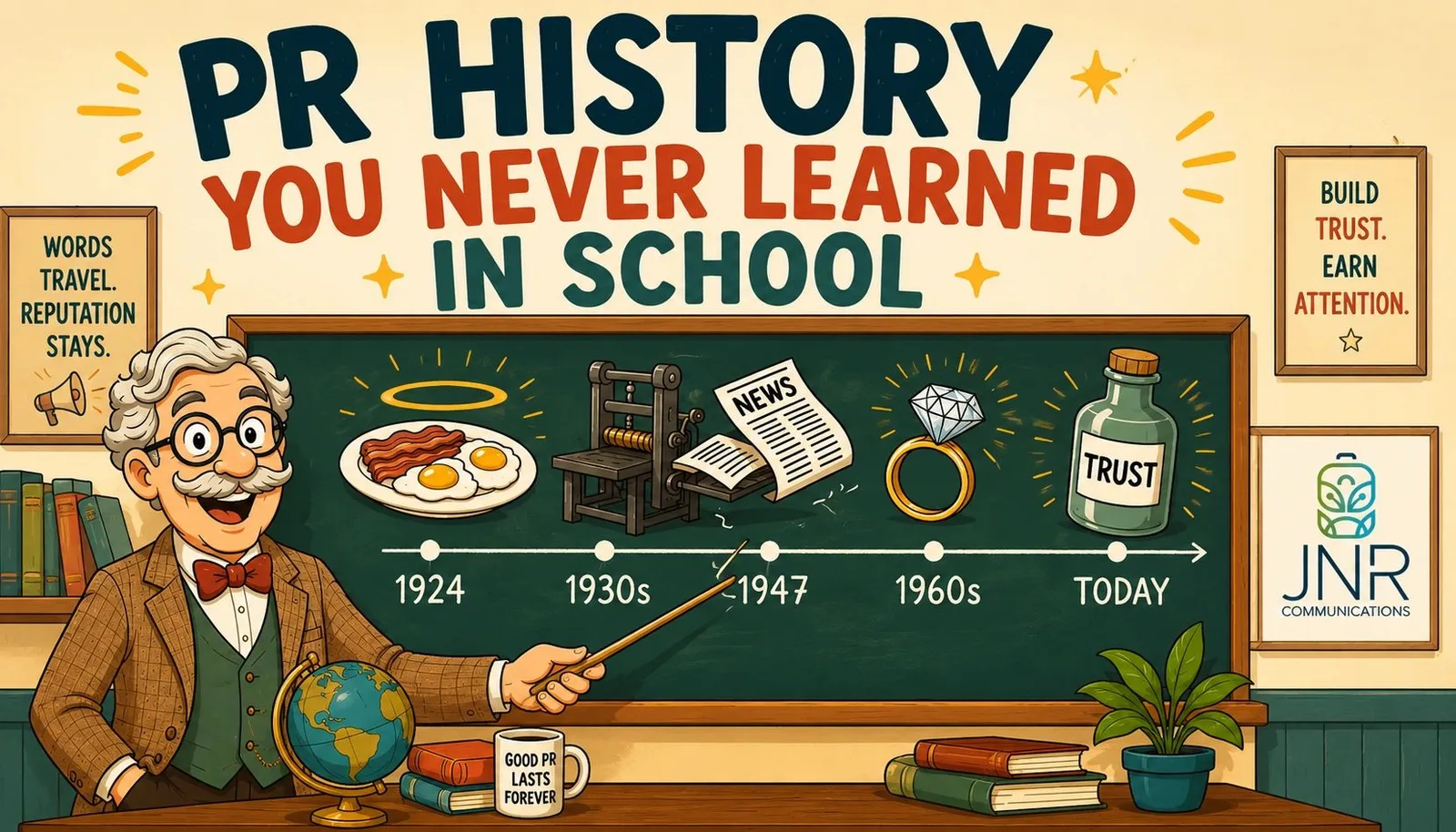
There is a version of public relations history they teach in textbooks, all press releases and communication models and tidy timelines. Then there is the real story, the one full of parades, carved soap, fake breakfast science, and a woman who never actually existed but somehow became one of the most trusted names in America.
I love the real story. In my years building relationships across industries, from healthcare technology to international business, I have come to believe that you cannot understand where PR is going until you understand the strange and very human place it came from. So let me take you on a tour of the PR history you never learned in school, and along the way I will point out the one lesson that keeps repeating itself. The campaigns that lasted were built on trust. The ones we side-eye today were built on manipulating it.
Let's dig in.
The nephew of Freud who taught America to smoke
If there is a single founding character in modern PR, it is Edward Bernays, and yes, he really was Sigmund Freud's nephew. He borrowed his uncle's ideas about the subconscious and put them to work selling everything imaginable.
His most infamous stunt came in 1929. The American Tobacco Company wanted to break the social taboo against women smoking in public. Bernays hired a group of young women to march in New York's Easter Sunday Parade while lighting up cigarettes, and he framed the whole thing as a bold statement about women's equality. He called the cigarettes "Torches of Freedom." The press covered it as a news event, not an ad, and the taboo cracked.
It is brilliant and it is troubling, all at once. Bernays understood something most businesses still miss: people do not respond to products, they respond to meaning. The problem was that he was willing to attach almost any meaning to almost anything if the check cleared.
How bacon and eggs became "the American breakfast"
Here is my favorite Bernays story, because you probably ate the result this morning.
Hired to sell more bacon, Bernays did not run a single ad about how tasty bacon is. Instead he had a physician survey thousands of doctors, asking whether a hearty breakfast was better for you than a light one. When the doctors said yes, he publicized that finding widely, with bacon and eggs offered up as the obvious hearty example.
The idea that bacon and eggs is the classic American breakfast is, to a real degree, a PR campaign we are all still living inside. What I take from it is not the trickery. It is the insight that third-party credibility beats self-promotion every time. When a trusted voice vouches for you, it lands in a way your own marketing never can. That principle is still the beating heart of good PR, and we use a healthier version of it every day.
The train wreck that invented the press release
Not everyone in early PR was playing games. In 1906 a man named Ivy Lee did something genuinely radical. When a Pennsylvania Railroad train derailed, the standard corporate move was to hush it up. Lee did the opposite. He invited reporters to the crash site and handed them a written statement laying out the facts.
Historians often call this one of the first modern press releases. More important, it introduced an idea that felt almost reckless at the time: that honesty could be a strategy, not a liability. Lee even wrote a "Declaration of Principles" promising to give the press accurate, open information.
I think about Lee a lot. He understood that trust is not something you spin up in a crisis. It is something you have already built, or you have not. You cannot fake it in the moment when it counts.
Rockefeller, the dimes, and the first great image makeover
Ivy Lee also took on one of the hardest reputation jobs in American history. After the deadly 1914 Ludlow Massacre at a Rockefeller-owned mine, John D. Rockefeller was among the most hated men in the country.
Part of Lee's approach was to humanize him, including the now-famous practice of Rockefeller handing out shiny dimes to children and strangers he met. It became a symbol, a small and repeatable gesture of generosity.
Now, I will be honest with you. A reputation cannot be rescued by dimes alone, and it should not be. But the underlying instinct was right: people connect with people, not with faceless corporations. If you want to be trusted, you have to be seen as human, and you have to actually behave like one.
P.T. Barnum, the original hype machine
Long before anyone said "influencer," there was P.T. Barnum. He was staging spectacles purely to get people talking. In 1850 he orchestrated a wild publicity frenzy around the American tour of singer Jenny Lind, whom almost no one here had heard sing. By the time she arrived, crowds were desperate for tickets.
The famous line "there is no such thing as bad publicity" often gets pinned on Barnum, though there is no solid proof he ever said it. What is real is his instinct for spectacle. And here is where I gently disagree with the Barnum school. Attention is not the same as trust. You can get a room to look at you and still have no relationship with anyone in it. Barnum got the looking. The lasting brands learned to earn the trusting.
Betty Crocker, the most famous woman who never lived
In 1921 the Washburn-Crosby Company had a problem. Customers were writing in with baking questions, and the responses needed a warm, personal signature. So they invented one. Betty Crocker was a name and a persona, not a person. She got a portrait, a radio show, and eventually was voted one of the most recognized and trusted women in America.
Think about that. A company built such a genuine sense of relationship with its audience that people felt they knew someone who did not exist. Now, I am not suggesting you invent a fictional spokesperson. But the lesson underneath is real and it is one we lean on constantly: audiences crave a human connection with the brands they buy from. Give them a consistent, warm, trustworthy voice and they will keep coming back to it.
The line that invented a tradition
In 1947, a young copywriter named Frances Gerety was working late and scribbled down four words for the diamond company De Beers: "A Diamond Is Forever." That single line reshaped an entire culture. It cemented the idea that an engagement ring should be a diamond, and even suggested how much you ought to spend.
An expectation that feels ancient and universal was, in fact, engineered and marketed into existence within living memory. Whenever someone tells me a "tradition" cannot be changed, I remember that a lot of them were simply well-told stories that stuck. Stories are that powerful. That is exactly why we owe it to our audiences to tell true ones.
The recall that rewrote the crisis playbook
Now for the story I wish every business owner knew. In 1982, someone laced Tylenol capsules with cyanide in the Chicago area, and seven people died. The tampering was not Johnson & Johnson's fault. Yet the company pulled roughly 31 million bottles from shelves nationwide, at a cost of more than 100 million dollars, and communicated openly and constantly with the public throughout.
They put safety ahead of profit, and they did it in plain sight. The brand not only survived, it became the gold standard for handling a crisis with integrity. This is the whole thesis of relationship-based PR in one example. When you have spent years being trustworthy, people extend you grace in your worst moment. The relationship was the insurance policy.
The propaganda office that trained an industry
During World War I, the United States created the Committee on Public Information, known as the Creel Committee, to rally public support for the war. It mobilized artists, writers, and speakers on an enormous scale. When the war ended, many of the people who worked there, Bernays among them, carried those persuasion techniques straight into the young private PR industry.
So much of what became modern PR was forged in that moment. It is a reminder that these tools are neutral until we decide what to do with them. The same techniques can build genuine understanding or cheap manipulation. The choice has always been ours.
What all of this taught me
Here is the thread running through every one of these stories. The stunts got attention. The relationships built empires. Bernays could make you look. Ivy Lee and Johnson & Johnson made you trust. And trust is the only one of those that compounds over time.
That is why, in my experience, the most powerful PR does not start with a press release or a clever stunt. It starts with relationship infrastructure, the web of genuine connections and earned credibility that makes every tactical effort actually work. The history of PR is really a long argument for the same thing we believe today: give value first, be honest, show up as a human, and build the relationship before you need it.
The tools have changed. The truth has not.
Ready to build PR that lasts? Building genuine connections takes time, but it is the foundation of PR that actually works. At JNR Communications, we combine our nearly 30 years of media relationships with strategic networking expertise to help businesses in beauty, wellness, medical aesthetics and CPG brands achieve visibility that generates real results. Let's talk about your goals.
✉️ Greg@JNRcommunications.com