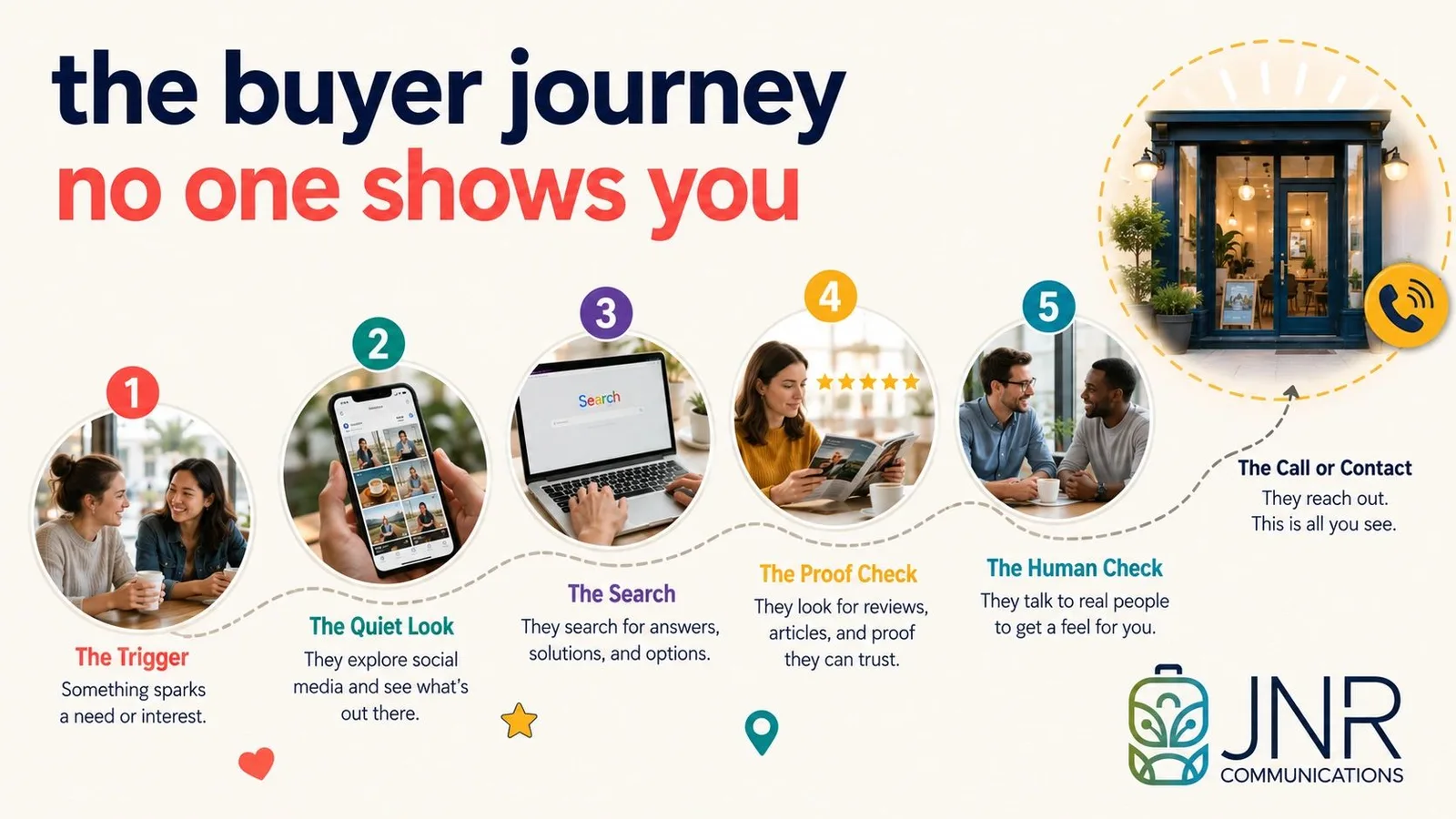
Before anyone books, they scroll, search, check reviews, and ask a friend. Social media covers one stop of five. Here is the whole path.
Last year a friend asked me to recommend a med spa for her mother. I gave her a name, and then I watched what she actually did with it.
She did not call. She opened Instagram and looked at the account for maybe ninety seconds. Then she Googled the name. Then she read reviews, including two bad ones from three years ago, closely. Then she clicked a link to a magazine piece where the practice was mentioned. Then she texted a different friend, a nurse, to ask if she had heard of them.
Then she called.
Five stops before the phone ever rang. And the practice she called could only see the last one.
This is the part of buying that nobody shows you, and it is why so many business owners feel like their marketing is working and their growth is not. You are watching the finish line. Your client is walking a path you never see. If you only show up at one point on that path, you are counting on people to fill in the rest for you. Most of them will not. They will just quietly choose someone whose path was easier to walk.
So let me walk it with you, stop by stop, and be specific about what has to be in place at each one.
Stop 1: The trigger
Nothing starts with your marketing. It starts with a moment in someone's life. A milestone birthday. A comment in a photo. A recommendation from a friend at lunch. A patient of another provider asking a question that provider does not handle.
You cannot control the trigger. But you can control whether your name is anywhere near it when it happens.
This is why relationship work matters long before anybody is shopping. When a dermatologist gets asked about a treatment she does not offer, she says a name. When a hairstylist hears a client mention a concern, she says a name. The name she says is the person she knows and trusts, not the person with the best ad.
What has to be in place: people who can say your name in rooms you are not in. That is not a campaign. That is relationship infrastructure, built one conversation at a time, well before you need it.
Stop 2: The quiet look
Now they check your social. Anonymously, quickly, and with a level of scrutiny you would find alarming if you could see it.
They are not reading your captions the way you wrote them. They are scanning for signals. Does this look current, or did it stop in March? Do the results look like me, or like somebody twenty years younger? Does this feel like a place where I would be comfortable? Is there a human here?
Ninety seconds, tops. And then they either continue down the path or drop out of it entirely.
What has to be in place: a feed that is current, consistent, and honest about who you serve. Not viral. Current and consistent. In my experience the businesses that lose people here are almost never the ones with bad content. They are the ones with a three-month gap, or a feed so polished that no actual person appears anywhere in it.
Stop 3: The search
Then they type your name into Google.
This is the stop most owners have simply never looked at. So do it right now, in a private window, and read the whole first page the way a stranger would.
What is there? Your website, hopefully. Your Google Business Profile with your hours and your star rating. Maybe a directory listing you forgot about. Maybe an article. Maybe an old address. For a lot of businesses, page one is thin, and thin reads as small.
There is a second version of this search too, and it is the one that brings you people who have never heard of you: the service search. Someone types the treatment and the city instead of a name. If you appear nowhere in that search, you were never in the running, and you will never know it happened.
What has to be in place: a website that loads fast and says clearly what you do and who you do it for, an accurate and active Google Business Profile, and content that answers the questions people actually type. This is the least glamorous work in marketing and consistently the highest-converting, because a person who searched is much further along than a person who scrolled.
Stop 4: The proof check
Here is where the decision usually gets made, and it is entirely out of your hands.
They read reviews. Not the star average, the actual words, and especially the negative ones. They are looking for a pattern and for how you responded. A thoughtful reply to a hard review does more for you than five glowing ones, because it shows how you behave when things go wrong.
And they look for third-party proof. A mention in a publication they recognize. A quote from you as the expert in a trend piece. An award. Anything that says somebody outside your own marketing department thinks you are credible.
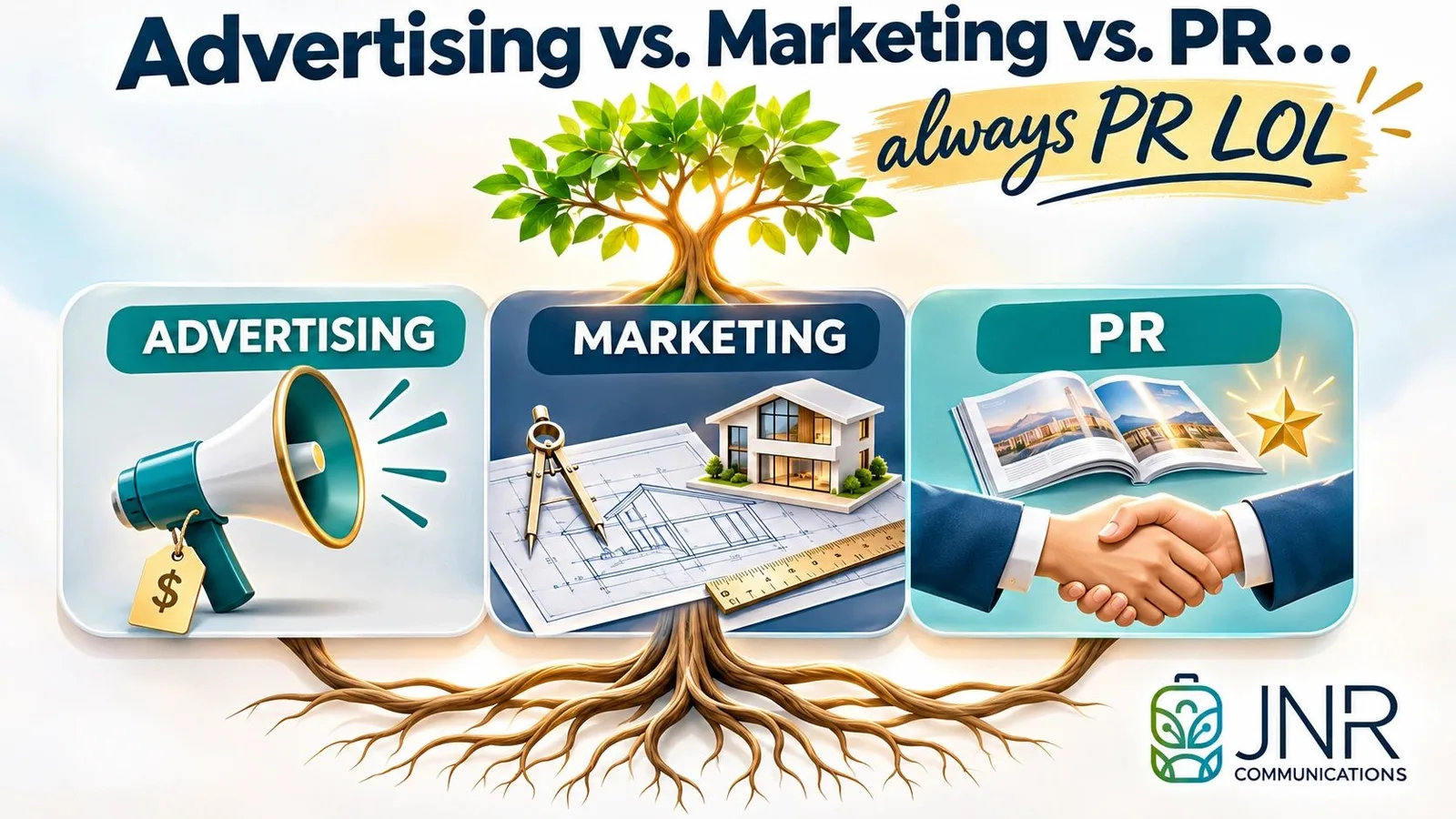
This is the difference between marketing and PR in one sentence. Marketing is what you say about yourself. PR is what other people say about you. At this stop, only the second kind counts. You cannot vouch for yourself here, no matter the budget, because credibility by definition has to come from somewhere other than you.
What has to be in place: a steady flow of recent reviews, real responses to all of them, and at least one piece of earned coverage a stranger can find. If a prospect goes looking for outside proof and finds nothing at all, you have handed the decision to whoever does have it.
Stop 5: The human check
Almost nobody skips this one, and it is the stop that no dashboard will ever show you.
They ask somebody. A friend, a colleague, their own doctor, a group chat, a local Facebook group. They want one person to say "yes, they are good" before they commit.
I spent years in referral networking rooms, and this is exactly the moment all that patient relationship work is for. Every peer, referral partner, and past client who genuinely knows you is a potential yes at this stop. Every one of them who does not quite know what you do, or who you serve, is a shrug. And a shrug at stop five kills a decision that survived the other four.
My time in Japan drove this home in a way I have never forgotten. In that business culture, you do not walk in cold and close a deal. The groundwork happens quietly, over time, with the people around the decision, long before anything formal is proposed. The business follows the relationship. It works exactly the same way here, we are just less honest about it.
What has to be in place: a network of people who can describe what you do in one clear sentence, and who have a reason to be glad they know you. Givers Gain is the operating principle. Give value first, consistently, with no immediate agenda, and the yeses take care of themselves.
The finish line: the reach out
Now, finally, they contact you. And here is the part that breaks my heart a little, because the leak at the last step is the easiest one in the world to fix.
How long does it take a real human to respond? What does the intake conversation feel like? Does the experience match the promise the whole path just made?
I have watched businesses invest serious money in visibility while quietly losing people to a form nobody checks on weekends. If you fix one thing after reading this, make it this one.
Where JNR Communications fits
I want to be straightforward about what we actually do, because "we do PR" is not a useful answer.
Most agencies sell you activity at one stop. What we care about is whether the whole path holds together for the person walking it.
At the trigger and the human check, the work is relationship infrastructure. Strategic networking, referral relationships, and community building, so your name is already in the mouths of the right people before anyone is shopping. That is the part of this business I personally love most.
At the quiet look, it is social media built as a relationship tool rather than a broadcasting channel. Current, consistent, recognizably human, aimed at the client you actually want.
At the search and the proof check, it is my partner Jennifer Rice's home ground. Nearly thirty years of media relationships, and the placements to show for it, including Good Housekeeping and New Beauty. Those relationships are why a journalist opens her email at all, and they are the reason a client of ours has something credible sitting on page one when a stranger goes looking. Add reputation work on reviews and a clear content plan, and stops three and four stop being a gamble.
And at the finish line, we will tell you honestly if your response process is undoing the rest of it. That conversation is free and occasionally uncomfortable.
We do this specifically for CPG brands, medical aesthetics, beauty, wellness, medical device, and adjacent brands, because the buying path in those categories is unusually long, unusually research-heavy, and unusually dependent on trust. Deep vertical knowledge matters more here than general marketing polish.
Walk your own path this week
Set aside forty five minutes and be your own prospect. Ask a friend to say your business name out loud to you, then do exactly what a stranger would do. Look at the feed. Search the name. Search the service and the city. Read your own reviews. Ask yourself who in your network could confidently vouch for you, and whether you have given them anything lately.
Then look at where you fell out of your own path. That is your next project, and it is almost never "post more."
The businesses that grow are not the ones that win at one stop. They are the ones that are still there at all five.
Want the whole path working, not just the part you can see? At JNR Communications, we combine Jennifer Rice's nearly 30 years of media relationships with strategic networking expertise to help businesses in beauty, wellness, and medical aesthetics achieve visibility that generates real results. Let's build your relationship infrastructure together.
📞 (818) 357-7286 | ✉️ Greg@JNRcommunications.com