Run the numbers on your last new client.
You paid for the ad or the content or the event that put you in front of them. You paid for the website that answered their questions. Somebody spent time on the phone. Add it up honestly and most practices are spending real money to turn a stranger into a booked appointment.
Then they book.
And for the next nineteen days, you say nothing to them at all.
Well, not quite nothing. A confirmation email fires automatically. A reminder text arrives the day before, generated by software, signed by nobody. Somewhere in there is a form to fill out.
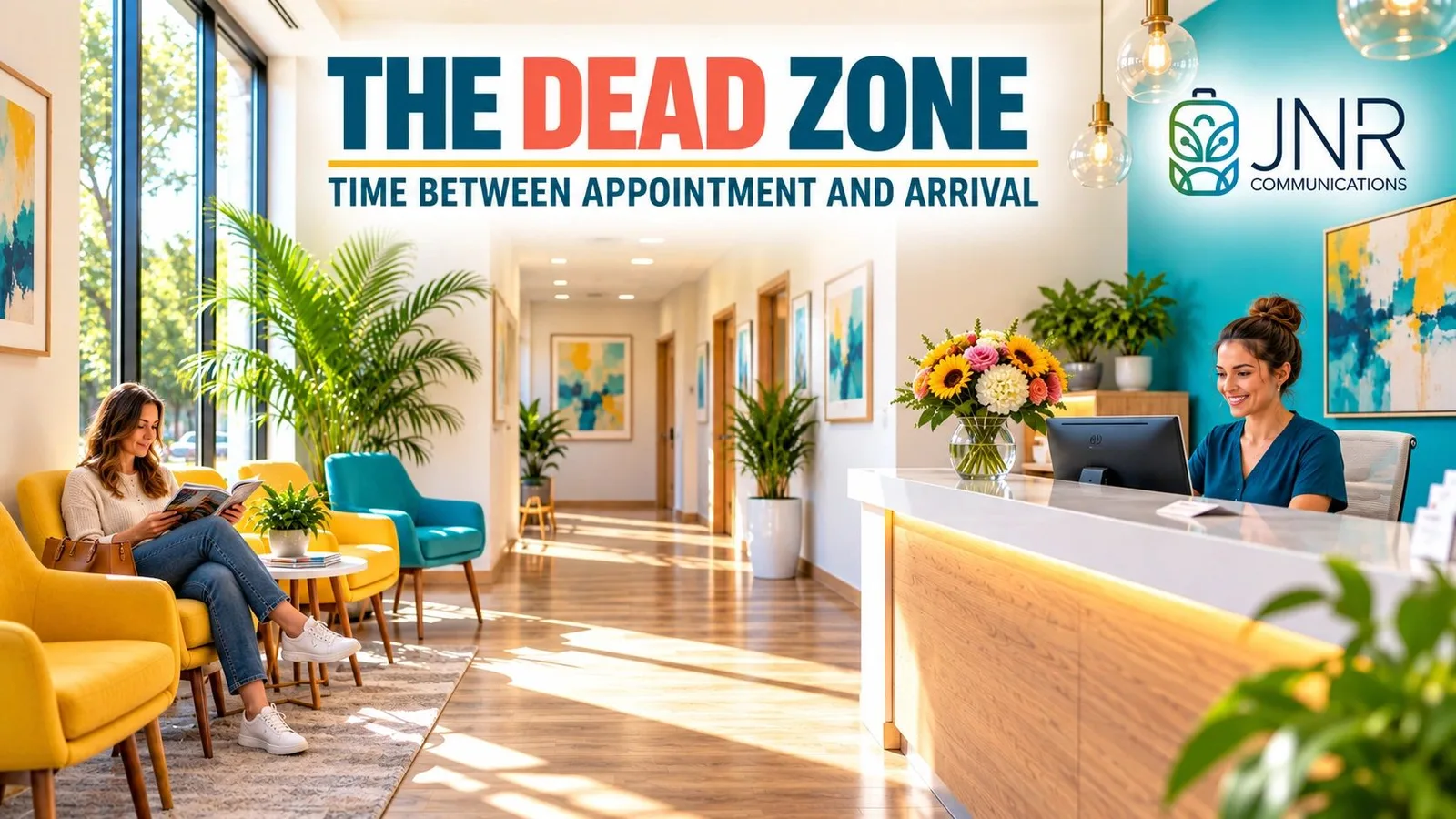
That is the dead zone, and it is the most expensive silence in your business.
The gap nobody owns
Here is why this happens. Marketing content ends at the conversion. Every article, every course, every consultant stops at the moment of booking, because that is where the funnel diagram ends.
Customer service content starts at the appointment. Greeting the client, the experience, the follow up.
Between those two bodies of advice is a stretch of days or weeks that belongs to nobody. Marketing thinks it is operations. Operations thinks it is marketing. The scheduling software thinks it is a reminder problem, which is why it sold you reminders.
So the gap sits there, unmanaged, doing one of two things. It is either building confidence or letting it drain. It is never neutral.
What actually happens in those nineteen days
I spent years designing training programs for clinicians rolling out new healthcare systems, and the thing that determined whether someone showed up prepared on day one was never the reminder email. It was whether the time between signing up and starting made them feel more certain or less.
Certainty decays in silence. That is the whole mechanism.
In the gap, a few things happen to a person who booked with genuine enthusiasm.
The enthusiasm fades. Not into doubt, just into ordinary life. The thing that felt urgent on Tuesday is competing with a car repair by the following Monday.
The anxiety grows. They are not thinking about the outcome anymore, they are thinking about the unknowns. Will it hurt. Will I look strange afterward. Will someone make me feel silly for asking. Will I be pressured into something bigger than I came for.
They look again. A person with two weeks to wait will absolutely browse your competitor once more, not because they are shopping, but because they are still nervous and browsing is what nervous people do.
And somebody talks to them. A spouse, a friend, a sister. "How much? For that?" Your client is now defending a decision alone, with whatever information they happen to remember, which is usually less than you think.
None of that is visible to you. All of it shows up in your schedule as a no show, a reschedule, or a consultation that starts colder than it should.
Logistics is not reassurance
Do the exercise before you read the fix. It takes ten minutes.
Count the days between when a new client books and when they walk in. Then list every single message they receive in that window. Every email, every text, every form.
Now mark each one as either logistics or reassurance.
Logistics tells them where to park, when to arrive, what to sign, what not to eat. Reassurance tells them they made a good decision, what is going to happen, and who they will be meeting.
Nearly every business I have done this with discovers the same thing. Everything on the list is logistics. Not one message in the entire window speaks to the actual emotional state of the person receiving it.
A reminder is not a relationship. It is a calendar entry with your logo on it.
The three messages that fill the gap
You do not need a campaign here. Three messages, written once, sent on a schedule, and they can be automated as long as they do not sound automated.
Message one, within a day of booking: what happens next. While the enthusiasm is still high, confirm the decision. A short, warm note in a human voice that says what the visit will actually be like, start to finish. Not the clinical steps, the experience. You will arrive, you will sit with someone for about twenty minutes, they will ask you what is bothering you, nothing gets done that day unless you want it done.
This message exists to answer the question nobody asks out loud, which is "what am I walking into."
Message two, midway: what other people were nervous about. This is the one almost nobody sends and the one that does the most work.
Two or three sentences naming the concerns real clients bring in, and how you handle them. "Most people ask us about downtime, about how natural it will look, and about whether we will try to sell them something bigger. Here is our answer to all three."
Normalizing the worry is worth more than answering it. Nervous people are mostly worried that their worry is unusual.
Message three, two or three days out: who they will meet. A name, a photo, one human sentence about the person. "Maria will be taking care of you. She has been with us seven years and she is the one everyone requests for first visits."
Strangers cancel on businesses. People do not cancel on people. This single message changes no show behavior more than any fee structure I have seen, because it converts an appointment with a company into an appointment with Maria.
If the wait is longer than two weeks
Add one thing: a check in from a real person that invites a reply.
Not a newsletter. One sentence from your front desk asking whether any questions have come up since they booked. Half will not reply. The ones who do will hand you the exact objection that was going to kill the appointment, three weeks before it does.
That is not customer service. That is the cheapest market research in your business, and it arrives in your inbox unprompted.
The one line for your confirmation
Most practices try to solve no shows with a deposit or a cancellation fee. Those work, and they also teach your client that the relationship begins with a penalty.
Try this first. Add one line to the confirmation:
"If something changes, just text us. We would much rather move it than lose you."
It sounds like it would increase cancellations. In practice it converts silent no shows into reschedules, because it removes the thing that actually causes a no show, which is not indifference. It is embarrassment. People who feel awkward about canceling do not cancel. They vanish.
Give them a dignified exit and most of them use it to stay.
Make it sound like a person
One caution. All of this can be automated and none of it should sound automated.
Write these three messages in the voice of whoever your clients would recognize, and sign them with a real name. Skip the header image, the brand fonts, the four social icons. A plain text message from Maria at the front desk will outperform a beautifully designed template every time, because it looks like something a person decided to send.
The moment it looks like a campaign, it gets read like a campaign, which is to say not at all.
What you can do this week
- Count your dead zone. Days between booking and arrival, and every message in between.
- Mark each message logistics or reassurance. Be honest about the ratio.
- Write message three first, the one that introduces the person they are meeting. It is the shortest and it moves the most.
- Add the "just text us" line to your confirmation today.
You spent real money to earn that appointment. Then you left the person alone with their own imagination for three weeks and hoped a robot text would carry the relationship.
The businesses that win the gap are not doing anything clever. They are just the only ones who noticed it was there.
Building genuine connections takes time, but it is the foundation of PR that actually works. At JNR Communications, we combine Jennifer's nearly 30 years of media relationships with my strategic networking expertise to help businesses in beauty, wellness, and medical aesthetics achieve visibility that generates real results. Let's talk about your goals.
📞 (818) 357-7286 | ✉️ Greg@JNRcommunications.com
Greg Kaufman is a Partner at JNR Communications, where he focuses on social media strategy and business networking. His background spans healthcare technology, international business development, and strategic relationship building. Connect with him on LinkedIn.