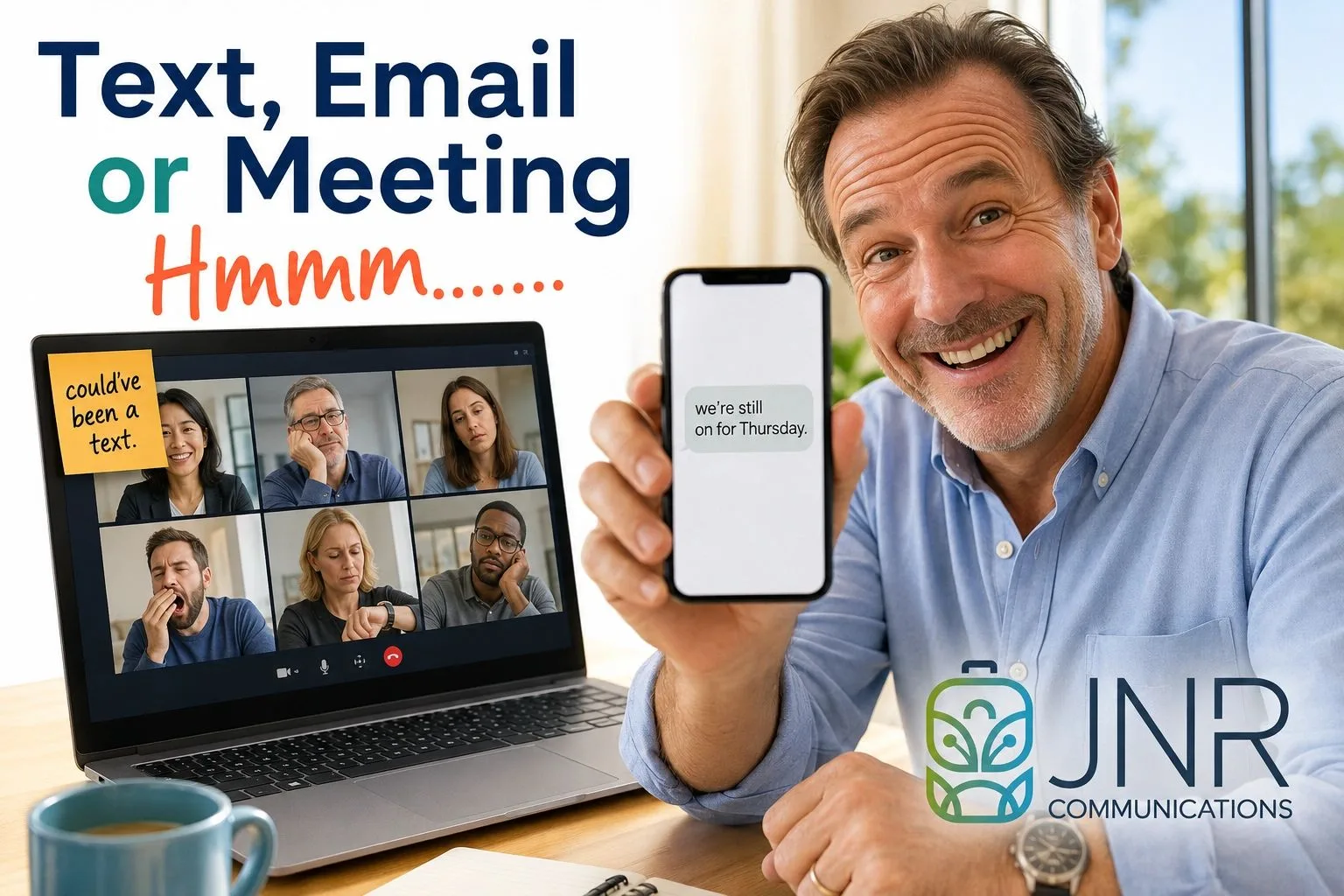
We have all survived it. The 30-minute video meeting that ends with everyone agreeing to the exact thing that was already written in the calendar invite. Six people. Half an hour. One decision that could have fit inside a single text message.
And we have all sent the other version too. The email that spirals into a fourth reply, then a fifth, then a "maybe we should just hop on a quick call?" that everyone wishes had been the first move instead of the last.
Here is a truth I have learned the slow way, across healthcare technology, international business, and years of professional networking: most communication problems are not actually about what you say. They are about where you say it. Pick the wrong channel and even a perfectly good message lands wrong, wastes time, or quietly chips away at a relationship you worked hard to build.
So let me offer what I wish someone had handed me twenty years ago: a field guide to choosing the right channel before you annoy an entire client roster.
Why the Channel Is the Message
There is an old idea in communication theory that the medium is the message. You do not need the theory to feel it. You already know that a breakup text feels different from a breakup conversation, and that "we need to talk" hits differently at 11 p.m. than it does over coffee.
The same is true in business, just with lower stakes and higher frequency. Every time you choose a channel, you are sending a second, silent message underneath the words. A same-day phone call says "this matters and you matter." A four-paragraph email at midnight says "please deal with this, but not right now." A meeting invite with no agenda says "I have not thought this through, so let's think out loud together, on your time."
Clients read those silent messages constantly, even when they could not tell you they are doing it. Get the channel right and people feel respected. Get it wrong repeatedly and they start to feel managed, or worse, ignored. In my experience, the professionals who are a joy to work with are almost always the ones who have quietly mastered this. They are not more talented communicators. They just know which door to knock on.
The Meeting That Should Have Been a Text
Let's start with the most over-served channel in modern business: the meeting.
Meetings feel productive. They fill the calendar with the comforting appearance of progress. But a meeting is one of the most expensive things you can ask of another human being. It costs their time, their focus, and the fifteen minutes on either side that nobody counts but everyone loses.
A meeting is the right call when you need real discussion: brainstorming, working through disagreement, making a genuinely complicated decision, or building the human connection that a screen cannot fully carry. Those are worth every minute.
But if the entire purpose of the meeting can be summarized as "confirm we are still on for Thursday," you did not need a meeting. You needed a text. Or a one-line message. Or a calendar confirmation that takes eight seconds to send and eight seconds to read.
Here is my simple test. Before scheduling anything, I ask: "Is there a real conversation here, or am I just transmitting information?" If I am transmitting information, a meeting is the wrong tool. Information wants to be written down, where people can reference it later without replaying a recording. Conversation wants to be live. Confusing the two is how you end up with a room full of people nodding at something that could have been a sentence.
The Email That Should Have Been a Call
Now for the opposite mistake, and it is just as common.
Email is wonderful for things that are clear, factual, and low on emotion. Confirmations, summaries, documents, "here is the file you asked for." It creates a record, it respects people's schedules, and it lets everyone respond when they are ready.
But email is a terrible place to have a delicate conversation. The moment a topic involves hurt feelings, real confusion, disagreement, or anything where tone matters more than facts, email quietly turns against you. It strips out warmth. It removes the pauses and the reassuring "no no, I totally get it" that keep a hard conversation from going sideways. And it hands both parties unlimited time to reread a sentence until they find the worst possible interpretation of it.
I learned this the hard way. Early in my career I tried to resolve a genuine misunderstanding with a client over email, carefully, thoughtfully, over several long messages. Each reply made it slightly worse, because we were both reading tone into words that had none. The moment we finally got on the phone, the whole thing dissolved in about ninety seconds. We were never actually far apart. The medium had manufactured a conflict that the words alone did not contain.
Now my rule is simple. When the emotional temperature of a message starts to rise, I change channels. If I catch myself writing a third careful paragraph trying not to be misunderstood, that is my signal to stop typing and pick up the phone. A five-minute call can save a five-day email thread and the relationship damage that comes with it.
A Simple Field Guide
Over the years I have boiled this down to a rough map. It is not a rigid rule, just a starting point that keeps me out of trouble.
Use a text or quick message for time-sensitive, simple, low-stakes things. "Running five minutes late." "Got it, thank you." "Are we still on?" Anything that needs a fast answer and carries no emotional weight belongs here.
Use email when the content is clear, factual, and worth keeping a record of. Recaps, documents, next steps, formal confirmations. Email is your filing cabinet, not your therapy couch.
Use a phone or video call when tone matters, when there is real back-and-forth, or when the relationship needs a human moment. Hard news, sensitive feedback, genuine brainstorming, and the first real conversation with a new client all belong on a call.
Use an in-person meeting for the highest-stakes moments and the relationships you most want to invest in. Big pitches, major decisions, and the trust-building that simply lands better face to face.
And use a handwritten note, which almost nobody does anymore, precisely because almost nobody does anymore. In a world of infinite digital noise, a real card stands out like a lighthouse. I have watched a two-line thank-you note do more for a relationship than a dozen perfectly optimized emails.
The Relationship Underneath the Rules
Here is the deeper point hiding inside all this channel-switching, and it is the point I care about most.
Choosing the right channel is not really a productivity hack. It is an act of respect. When you match the medium to the message, you are telling the other person: I thought about what this would be like to receive. I valued your time enough not to steal thirty minutes for a sentence. I valued our relationship enough not to hide a hard conversation behind a screen.
That is the whole game. Trust is built in small moments, and how you choose to reach someone is one of those moments, repeated dozens of times a week. Every well-chosen channel is a tiny deposit in the relationship account. Every meeting-that-should-have-been-a-text is a small withdrawal. Nobody notices a single one. Everybody feels the accumulated balance.
This connects to a principle I come back to again and again: Givers Gain. The most generous thing you can often give a busy professional is not more of your words. It is the right amount of your words, delivered in the way that costs them the least and respects them the most. Give people that consistently, and they start to look forward to hearing from you. That is rarer, and more valuable, than you might think.
Start Today
You do not need a new app or a new system to fix this. You just need one new habit: pause for three seconds before you reach out and ask, "What is the right door to knock on here?"
Is this a real conversation, or am I transmitting information? Is the temperature rising, and should I switch to a call? Would a text respect this person more than a meeting? Would a note mean more than an email?
Three seconds. That is the entire cost. And the return is a reputation as someone who is genuinely good to work with, which in this business is worth more than almost anything you can buy.
The meeting that should have been a text and the email that should have been a call are not just annoyances. They are missed chances to show people you respect them. Take those chances. Your clients, your colleagues, and your calendar will all thank you.
Ready to communicate in a way that builds relationships instead of straining them?
JNR Communications helps medical aesthetics, beauty, wellness businesses and CPG brands build the kind of strategic communication and relationship infrastructure that earns lasting trust. Let's talk about your goals.
✉️ Greg@JNRcommunications.c