
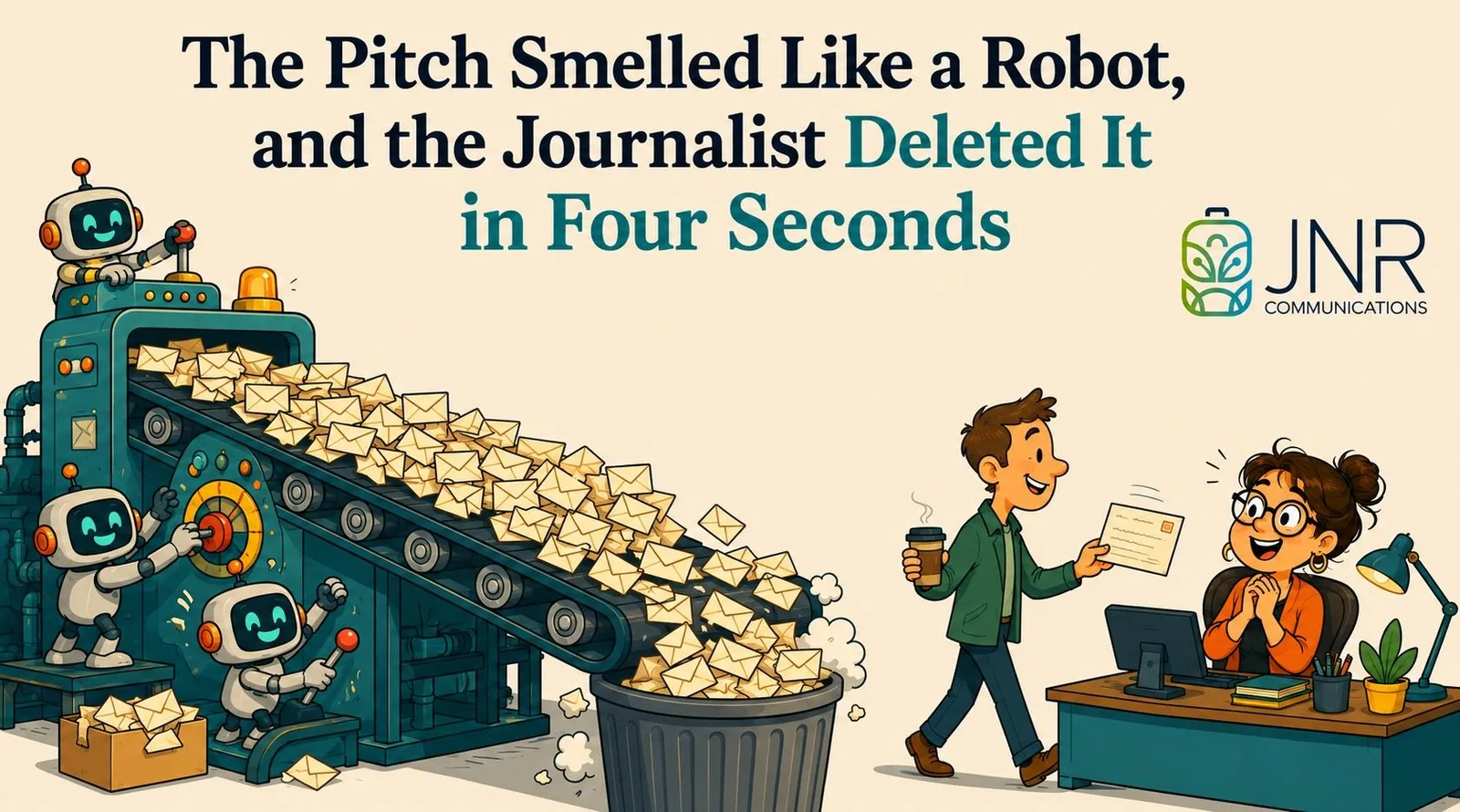
A reporter told me recently that she can spot an AI written pitch by the second line. I asked her how, expecting something technical. Some tell in the phrasing, a word choice, a rhythm.
Her answer was simpler and much more damning.
"Because it could have been sent to anybody."
That is the whole problem in one sentence. The tell is not that a machine wrote it. The tell is that nobody decided anything. No one chose her specifically, thought about what she covers, or had a reason for the message to land in her inbox instead of four hundred others.
And here is the part the industry keeps getting backward. She is not anti technology. She uses AI every day.
Journalists are not the ones resisting AI
If you assume reporters are holding out against these tools, the data says otherwise. Muck Rack’s 2026 State of Journalism report, based on responses from 897 journalists surveyed in early 2026, found that 82 percent now use at least one AI tool in their work, up from 77 percent the year before. They are power users, often ahead of the agencies pitching them.
Which makes the next number more interesting. Cision’s 2026 State of the Media report, covering 1,899 journalists, found that 53 percent oppose AI generated pitches specifically, and their stated reasons were accuracy and personalization.
Journalists are not rejecting AI. They are rejecting being on the receiving end of it.
They will happily use a tool to transcribe an interview. They will not happily be the target of an outreach machine that never considered them.
Volume was never the constraint
Here is what our industry did with the new capability. We got faster at the thing that was already not working.
The flood is measurable. Cision found that 72 percent of journalists say fewer than one quarter of the pitches they receive are relevant to them at all. Muck Rack found that 88 percent immediately delete pitches that miss their beat, and nearly half say they seldom receive pitches that match what they actually cover.
So the average inbox is mostly noise, and reporters have gotten ruthlessly efficient at clearing it. When someone tells me they can decide in four seconds, I believe them, because they have had to build that reflex to survive their own inbox.
Sending three times as many pitches into that environment does not increase your odds. It makes you part of the reason the filter got so aggressive in the first place. We collectively made the channel worse and then complained that the channel stopped working.
Volume was never the constraint. Relevance was. Trust was. Those are the two things a tool cannot generate on your behalf.
The good news is buried in the same reports
Now for the part that should genuinely encourage you.
Cision found that 66 percent of journalists rely on PR provided content for story ideas, making PR their leading source. Muck Rack found that 86 percent say PR pitches inspire at least some of their stories.
Reporters are not trying to get away from us. They are drowning, understaffed, on tighter deadlines, and they need good material. The door is not closed. It is wide open, and the line to get through it is enormous and mostly full of people who did not bother to learn what is on the other side.
That should reframe how you think about this entirely. You are not fighting for attention against journalists who dislike PR. You are trying to be the one message in the pile that is obviously, specifically for them.
What actually gives an AI pitch away
I have looked at hundreds of these, and the tells are almost never about the writing quality. The prose is usually fine. That is the point. The tells are about the thinking that did not happen.
It compliments work that does not exist. "I loved your recent piece on innovation in the industry." Nobody wrote that piece. That sentence is a slot with a category dropped in.
The angle fits any outlet. If the same pitch could go to a trade publication, a local business journal, and a consumer magazine without changing, then it was written for none of them.
It is structured too evenly. Three balanced paragraphs, each about the same length, a tidy summary, a polite close. Real pitches from people who know a beat tend to be lopsided. They get to the interesting part fast because the sender knows what is interesting.
It offers access without specifics. "Our expert is available to comment on industry trends." On what, exactly? For whose audience? Vagueness is the fingerprint of a message written before anyone decided what it was for.
There is no evidence of a relationship or a reason. No reference to a past conversation, a story they actually wrote, or a fact about their audience. Nothing that could only have been written to this person.
None of these are AI’s fault. A skilled person using AI badly produces exactly the same artifact. The tool just made it possible to produce it at scale.
Where AI genuinely helps in media relations
I am not arguing for doing this the hard way out of nostalgia. I use these tools constantly, and there is real leverage in them. It is just on the other side of the process.
Use AI to research a journalist’s recent work and summarize what they actually cover. Use it to map which of your story angles fits which beat. Use it to sharpen a subject line you already wrote, to prepare for an interview, to organize a client’s data into something a reporter could actually use, to draft the follow up resources you send after the conversation.
That is the preparation layer, and AI makes it dramatically faster. Ten years ago the research that now takes twenty minutes took an afternoon.
What it should not touch is the outreach itself, because the outreach is the part where a specific human being decides that a specific other human being would find this useful. Outsource that and you have outsourced the only thing that was ever going to work.
What journalists say they actually want
Cision asked, and the answers were remarkably concrete. Original research. Access to real experts. Embargoed information.
Look at that list closely. Not one of those items can be generated. They are all things you either have or you do not, and they all come from doing real work and building real relationships in advance.
This is where I think about what my partner Jennifer Rice has built over nearly thirty years. When she reaches out to an editor, the message lands differently, and not because the sentences are better. It lands because there is history behind it. She has been useful to that person before, without an ask attached. She knows what their audience cares about. She has never wasted their time.
That is not a technique anyone can copy this quarter. It is an asset that took decades to build, and it is the reason the pitch is really the last five percent of the work.
What to do this week
Cut your list by 80 percent. Take the twenty five reporters you were going to contact and pick five you can honestly justify. If you cannot name something specific they have written and why this matters to their readers, they do not make the cut.
Read three of their recent pieces before writing a word. Use AI to find them faster if you like. Read them yourself.
Give before you ask. Send one journalist something useful with no request attached. A data point, a source, a correction, a heads up. Do that a few times a year, consistently, and in eighteen months you will have something no automation can manufacture.
Givers Gain works in media relations exactly the way it works in a networking group. The only difference is the timeline.
The reporter who deletes your pitch in four seconds is not your enemy. She is a busy professional protecting her ability to do her job. Be the message that makes her day easier, and she will remember you long after the flood has been forgotten.
Ready to build media relationships that actually open doors? At JNR Communications, we combine Jennifer Rice’s nearly 30 years of media relationships with my strategic networking expertise to help businesses earn coverage that generates real results. Let’s talk about your goals.
📞 (818) 357-7286 | ✉️ Greg@JNRcommunications.com