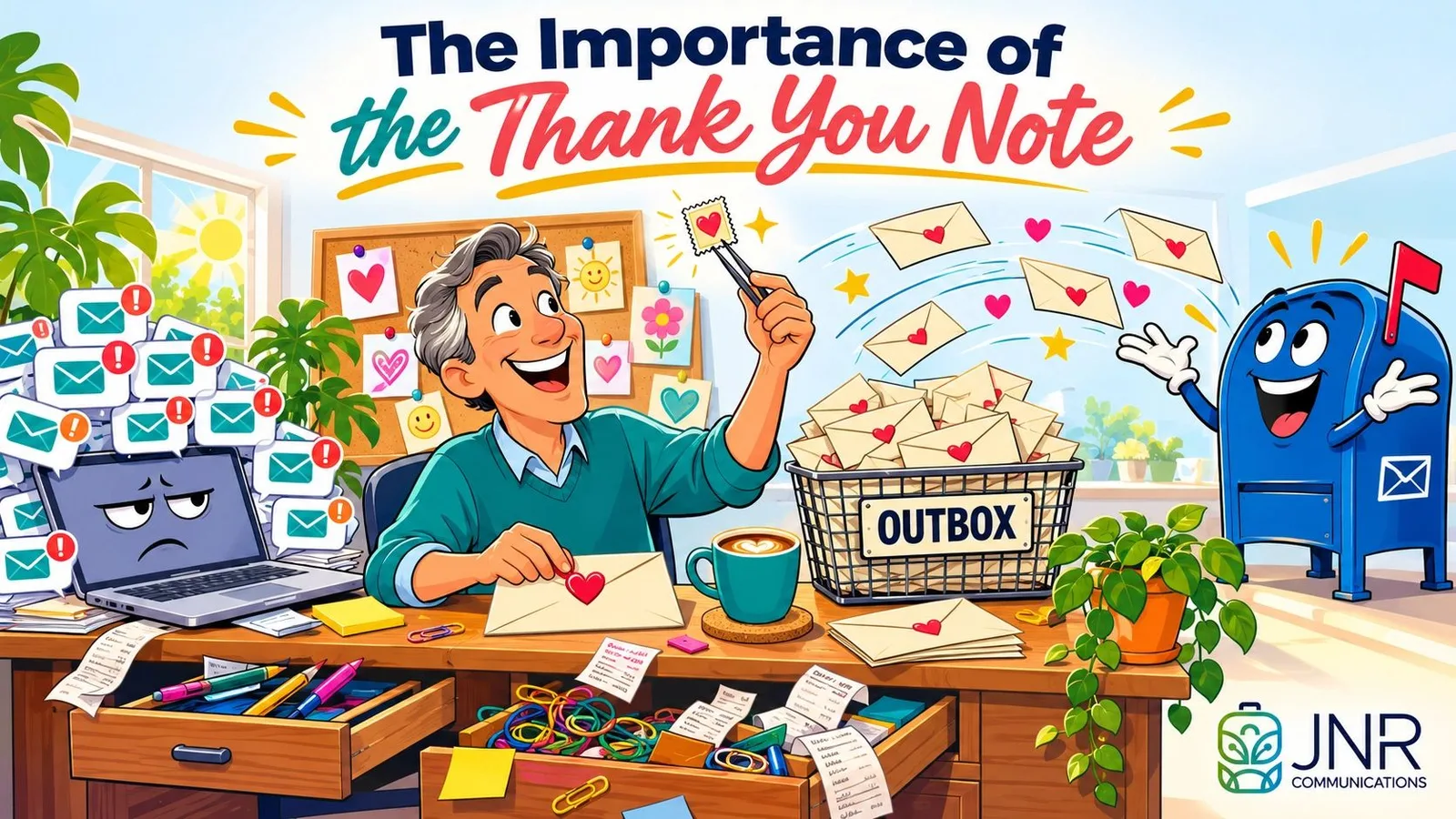
Last month I went looking for a stamp. This should have been simple. I am a grown man with a home office, a printer, and an embarrassing number of pens. And yet I spent twenty minutes opening drawers like a raccoon searching a campsite before I found a single, slightly curled Forever stamp tucked behind a 2019 tax receipt.
Then I sat down to write a thank-you note and discovered something even more alarming. My handwriting has gotten worse. Much worse. Somewhere between texting with my thumbs and typing all day, my penmanship devolved into something a pharmacist would squint at.
I wrote the note anyway. Three sentences. A colleague had made an introduction that turned into a great new relationship, and I wanted her to know it mattered.
A week later she called me. Not to talk business. Just to say the card was sitting on her desk, and it made her day.
That is the thing about thank-you notes. They cost less than a latte, take less time than scrolling one Instagram reel, and somehow outperform most of the marketing we pay good money for.
Let me make the case for bringing them back.
Why a Piece of Paper Beats a Thousand Emails
Think about what lands in your inbox on a typical day. Newsletters. Invoices. Promotions. Meeting invites. "Just circling back" messages. A suspicious email informing you that you have won a cruise you never entered.
Now think about what lands in your physical mailbox. Bills, mostly. Catalogs. The occasional coupon for a mattress.
So when a handwritten envelope shows up with your name written by an actual human hand, it is an event. People open it first. They read every word. And very often, they keep it.
I have walked into offices where thank-you cards were pinned to a bulletin board years after they were sent. Nobody pins an email to a bulletin board. Nobody frames a text that says "thx!!"
A handwritten note says something no digital message can: I stopped what I was doing, picked up a pen, and spent a few minutes thinking only about you.
That kind of attention is rare. And rare things get remembered.
An email says "thanks." A handwritten note says "you mattered enough for me to find a stamp."
The Purest Form of Givers Gain
I have spent much of my career in networking circles built on the Givers Gain philosophy. The idea is simple: when you help others succeed without keeping score, the goodwill comes back to you in ways you cannot predict.
The thank-you note might be the simplest, most practical version of that principle. It asks for nothing. It sells nothing. It does not include a link to book a consultation. It simply acknowledges that someone did something kind.
And here is the funny part. Because it asks for nothing, it often brings more back than any pitch ever could.
In my experience, the people who send thank-you notes consistently become the people others want to refer. Why? Because they make it pleasant to help them. When you thank a referral partner for an introduction, you are telling them that their generosity landed somewhere good. That makes them far more likely to do it again.
What Japan Taught Me About Gratitude
When I lived in Japan as a scholar at Nagoya University, I was struck by how deeply gratitude is woven into everyday business life.
Take omiyage, the custom of bringing back small gifts from a trip for coworkers and colleagues. It is not about the gift itself. A box of local sweets is not exactly a luxury item. It is about the message: I thought of you while I was away.
Business cards are exchanged with two hands and a small bow, received with care, and studied for a moment before being put away. Thank-you messages after a meeting are expected, not exceptional. There are even phrases built specifically for thanking someone for their ongoing support and for the trouble they took on your behalf.
What I learned there is that gratitude is not a nice extra in a relationship-based culture. It is part of the infrastructure. It is how trust gets maintained between transactions.
American business culture tends to treat gratitude as something you express after a big win. Japan taught me that the small, regular thank-yous matter more. They keep relationships warm during the long stretches when nothing exciting is happening.
Who Deserves a Note (Hint: More People Than You Think)
Most business owners only think about thanking clients. That is a good start, but it leaves out most of the people who keep your business running.
Here is a short list to get you started:
- Referral partners who sent someone your way, whether or not it turned into business.
- Clients and patients on milestones: their first visit, an anniversary with your practice, or a big result.
- Journalists and editors who covered your story. Very few people thank reporters, which is exactly why you should.
- Vendors and suppliers who went above and beyond, like the rep who rushed an order before an event.
- Your own team. A handwritten note from the owner can mean more to an employee than a gift card.
- The person who said no but was kind about it. Thanking them keeps the door open for next time.
For med spas, dermatology practices, and wellness studios, the patient note is especially powerful. Imagine a client who just finished a treatment series receiving a short handwritten card from her provider, celebrating how far she has come. She is not going to keep that to herself. She is going to show it to her friends, and possibly post it. That is word-of-mouth marketing you cannot buy, and it started with a pen.
That journalist point deserves a moment. My partner Jennifer Rice has spent nearly 30 years building media relationships, and one of the quiet habits behind them is simple appreciation. When a reporter knows you value their work and their time, they remember you when the next story comes along. A thank-you note after a placement is not flattery. It is relationship maintenance.
How to Write a Thank-You Note Without Overthinking It
People skip thank-you notes because they think they need to be eloquent. They do not. The best ones are short, specific, and sincere.
Here is a simple three-part formula:
Name the specific thing. Not "thanks for everything," but "thank you for introducing me to Dr. Martinez."
Say why it mattered. "Our conversation turned into a wonderful new partnership, and I am grateful you thought of us."
Look forward, not for a favor. "I hope I can return the favor soon," or "I look forward to seeing you at the next event."
That is it. Three or four sentences. Sign your name. Find that stamp.
A few extra tips from someone who has learned the hard way:
- Write it within 48 hours. Gratitude, like guacamole, does not age well.
- Keep a box of blank cards and stamps at your desk so there is no excuse.
- Do not include a business card or a sales message. It turns a gift into an ad.
- If your handwriting is as bad as mine, write slowly. Legibility is a form of respect.
But What About Email?
To be fair, email and text thank-yous are not useless. They are fast, and in some situations, fast matters. A quick thank-you email after a meeting is good practice.
But think of digital thanks as the minimum and handwritten notes as the memorable. One gets read. The other gets kept.
The same principle applies to social media. Publicly thanking a referral partner or celebrating a client's milestone on LinkedIn is a wonderful way to give visibility to people who helped you. It also shows your network that you are someone who notices and appreciates others. That reputation is worth more than any ad campaign.
Your Thank-You Challenge
Here is my challenge for you this week. Write five thank-you notes. One to a client, one to a referral partner, one to someone on your team, one to a vendor, and one to anyone who has helped you in the past year without being asked.
Five notes. Maybe thirty minutes total. Five stamps, assuming you can find them.
I promise you will feel better writing them. And I suspect at least one of those notes will come back to you in a way you never expected, whether that is a phone call, a referral, or simply a stronger relationship with someone who matters.
The thank-you note never really left. We just stopped writing them. Let's start again.