
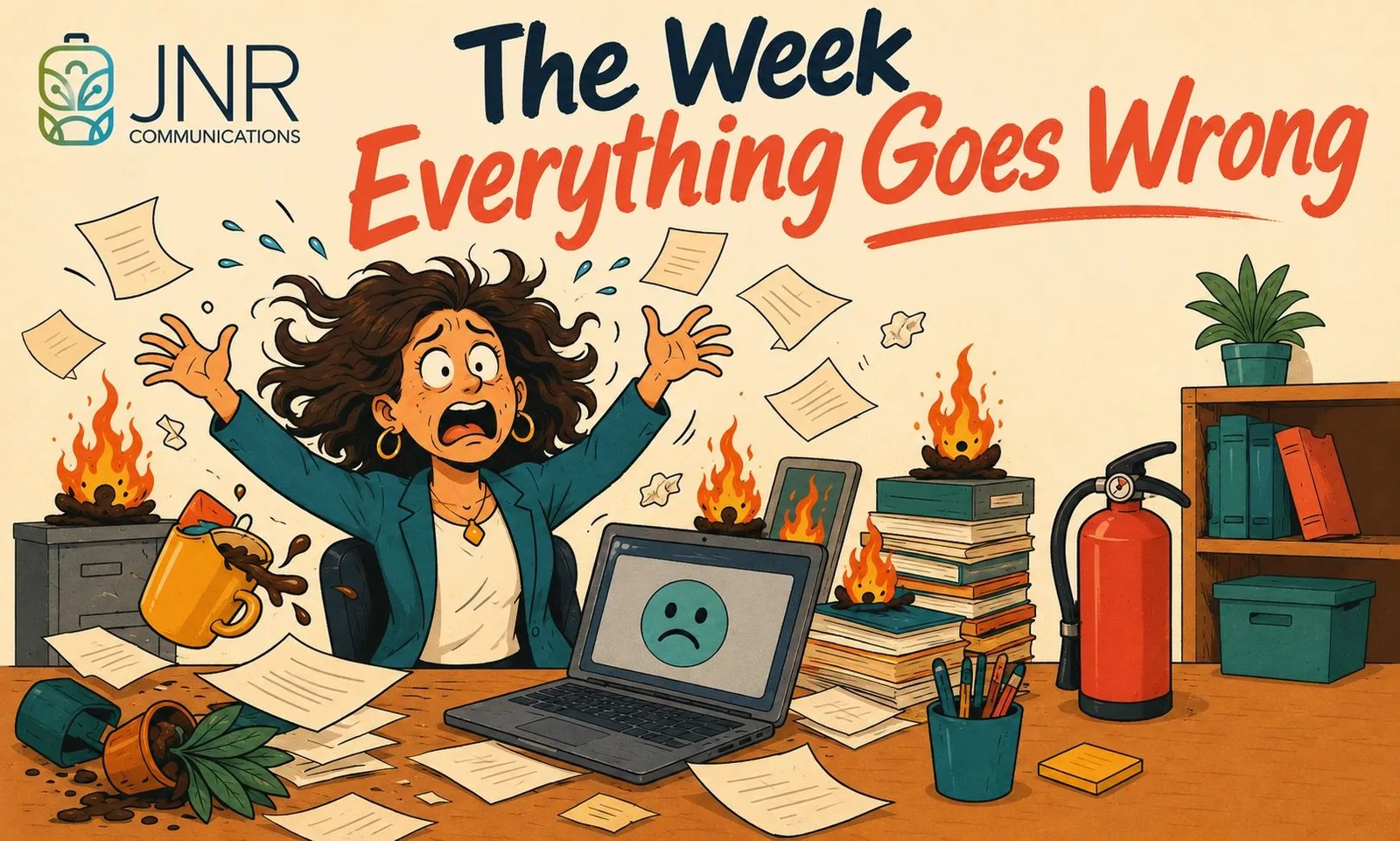
A bad review, a staff exit, a photo out of context. Here is the one-page crisis plan every small business should write while things are calm.
Nobody schedules a crisis for a convenient Tuesday.
It usually arrives like this. A one-star review appears at 7:40 in the morning, and this one is not a cranky sentence about parking. It is four paragraphs, specific, emotional, and written by someone who clearly knows how to tell a story. By 8:15 your front desk has seen it. By 9:00 two staff members have screenshotted it. By noon a friend texts to ask if everything is okay.
Or it is a valued employee leaving abruptly and saying something pointed on the way out. Or a photo from your holiday party surfacing without its context. Or a client escalating a complaint in a local Facebook group with eleven thousand members.
Here is what I have watched happen over and over: the owner writes the crisis plan during the crisis. That is the single worst moment to write one, because you are exhausted, defensive, and moving fast. Every instinct you have in that state is wrong.
The good news is that the plan takes about an hour to write, and you can write it this week, while nothing is on fire.
First, Sort What You Are Actually Dealing With
Not every bad day is a crisis, and treating an annoyance like an emergency is its own kind of damage. I use three levels.
An annoyance. One unhappy person, contained, no pattern behind it. A single negative review, a complaint email, a rude comment. Handle it well and quietly. Do not convene a meeting.
An incident. Something real happened that affected a client or an employee, and other people are aware of it. A service failure, a billing mistake that hit multiple people, a staff conflict that spilled into view. This needs a decision, a response, and a fix, but not a public statement.
A crisis. Something that threatens trust across your whole audience. Regulatory involvement, a safety concern, media attention, or a story spreading faster than you can talk to people individually.
Most of what feels catastrophic at 7:40 in the morning is an annoyance. Knowing the difference before you react is half the discipline.
The First Hour Is the Whole Ballgame
In the first hour, two things are true at once. You will not have all the facts, and silence will be read as an answer.
That tension is why the reflexes matter more than the words. Three rules.
Acknowledge faster than you explain. You can say you have seen it and are looking into it long before you know what happened. That single move buys you time and signals that you are not hiding.
Never respond from emotion. Write the angry reply. Then delete it. Then have one other person read the real one. I have never once regretted the twenty minutes that step cost me.
Take it out of public quickly and genuinely. "Please call me directly at this number, I want to understand what happened" is the strongest public reply in existence, because every other reader sees a business that is willing to pick up the phone.
The One-Page Plan
Write these four sections down and keep them somewhere your team can find them. One page. That is the whole thing.
1. Who speaks. Name one person. In a small business that is usually the owner, and that is fine, but it has to be decided in advance. Then write the sentence everyone else uses: "I want to make sure you get the right answer, let me have [name] get back to you today." Give it to the front desk, the newest hire, and anyone who answers a phone or a message. Confusion in the first hour comes almost entirely from good people improvising.
2. What gets said in the first hour. Draft the holding statement now, with blanks. Something like: "We are aware of the concern raised and we are looking into it directly. We take this seriously, and we will follow up. If you have been affected, please contact me at [number]." It is not thrilling. It is not supposed to be. It is supposed to be true, human, and available at 7:41 in the morning without anyone having to invent it.
3. What never gets said. This section protects you more than any other. Never argue facts publicly with an upset customer. Never speculate about what happened before you know. Never discuss a specific patient or client, and in medical aesthetics, dermatology, and wellness, this is not just a bad look, it is a privacy obligation. You may not confirm that someone is a patient at all, even when they have posted about it themselves. That constraint feels unfair in the moment, and it is still the line. And never let anyone say "no comment," which every reader hears as guilt.
4. Who gets called. List the actual phone numbers now: your attorney, your insurance contact, your PR counsel, and the two or three referral partners or long-standing clients who deserve to hear it from you rather than from the internet. That last group is the one people forget, and it is the one that protects your reputation the most.
Your Team Is Part of the Plan
Something I learned running technology rollouts in healthcare: when leadership goes quiet, staff fill the silence with speculation, and speculation walks out the door at the end of the shift.
Tell your team something the same day. It does not have to be everything. "Here is what we know, here is what we are doing, here is what to say if a client asks" is enough, and it keeps the people closest to your clients aligned and calm. Internal communication is external communication with a short delay.
Why Relationships Decide the Outcome
Here is the part most owners discover too late. In a real crisis, your outcome depends heavily on relationships that already existed. If a reporter calls, whether they have a relationship with you determines whether you get a fair phone call or a one-line quote request with a two-hour deadline. Jennifer's nearly 30 years of media relationships have mattered most for our clients on their worst days, not their best ones, because a journalist who knows and trusts your team will call before publishing rather than after.
The same applies to your referral partners, your long-term clients, and your community. Trust built during calm months is what you draw down in a difficult week. This is Givers Gain in its least glamorous and most valuable form. You cannot build that relationship infrastructure on the morning you need it.
After the Storm
Once it settles, do three things.
Fix the actual problem, and say so plainly. "We heard this, here is what changed" is one of the most trust-building sentences a business can publish.
Rebuild the proof. A rough stretch is exactly when your visible track record matters. Steady, consistent positive presence over the following months does more than any single response ever will.
Then update the one-page plan with what you learned. It gets better every time you use it, and if you are lucky you will not need it for a long while.
Write It This Week
Block one hour. Four headings. One page. Print it, put a copy at the front desk, and send it to your team.
You are not being pessimistic. You are being the kind of prepared that lets you stay calm on the morning something goes sideways, which is precisely when your clients are watching most closely.
Building genuine connections takes time, but it is the foundation of PR that actually works. At JNR Communications, we combine Jennifer's nearly 30 years of media relationships with my strategic networking expertise to help businesses in CPG brands, beauty, wellness, and medical aesthetics achieve visibility that generates real results. Let's talk about your goals.
✉️ Greg@JNRcommunications.com