A few months ago, I read a press release that confidently claimed the company had been named one of "Forbes Top 50 Most Innovative Companies for 2023."
The list does not exist. Forbes does not publish that list.
The press release was a draft. The team that produced it had not invented the award on purpose. They had let an AI tool generate the first draft and forgotten to check it before someone almost sent it out.
This is the world we are in now, and it is producing comedy of a very specific kind. AI tools are powerful, useful, and capable of saving real time. They are also confident in a way that is sometimes hilarious and sometimes alarming. They will tell you, with full conviction, that your client won an award that does not exist, was quoted in a publication they have never been in, and is "widely recognized" by people who have never heard of them.
Today I want to walk through what I have seen, what to watch for, and how to use AI tools without ending up in the comedy folder.
The Hits So Far
Here are some of the AI-generated PR moments I have personally witnessed in the past year. Names removed, details lightly fuzzed.
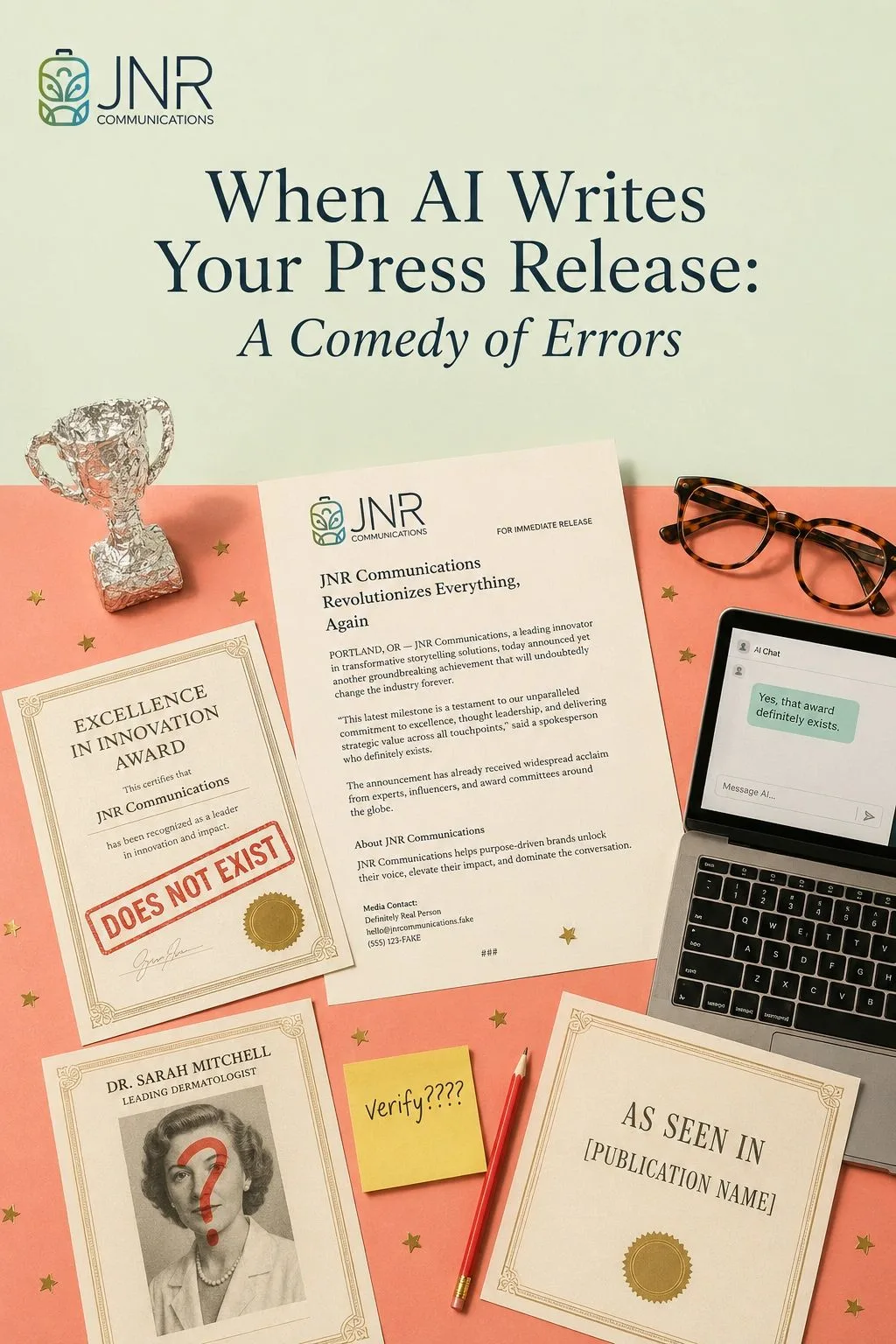
The Award That Does Not Exist. A wellness brand's draft release claimed they had been "honored at the prestigious 2023 National Wellness Industry Awards." There is no such organization. The AI invented it whole.
The Quote From Nobody. A draft included an enthusiastic quote attributed to "Dr. Sarah Mitchell, leading dermatologist at the Beverly Hills Skin Institute." Neither Dr. Mitchell nor the institute exists. The AI produced a credible-sounding endorsement from people who do not exist.
The Statistic From Thin Air. "According to a recent industry report, 87 percent of consumers prefer..." There was no report. The AI generated the stat to support the point the brand wanted to make.
The Press Coverage That Did Not Happen. A draft bio said the founder had been "featured in Vogue, Harper's Bazaar, and Marie Claire." She had not been featured in any of them. The AI assumed, because she is a beauty founder, that of course she had.
The Superlative Storm. "The leading provider of revolutionary, cutting-edge, award-winning, industry-defining solutions in the rapidly evolving aesthetic technology space." Six superlatives in one sentence. The company had been operational for four months.
The Wrong Industry. A press release for a med spa included a sentence about how the brand was "disrupting the food and beverage sector." That sentence was not removed before the release went out internally for review.
Why This Happens
AI tools are pattern matchers. They have read a lot of press releases, biographies, and news articles. When you ask them to write one, they generate the most statistically likely version of that thing. The statistically likely press release contains awards, quotes from experts, impressive coverage, and confident superlatives.
The AI does not know whether the specific awards, quotes, or coverage are real. It does not know that the company is four months old or forty years old. It does not know what is true. It only knows what press releases tend to sound like.
This is sometimes called hallucination, which is a polite term for confidently making things up. It is not a moral failing of the tool. It is how the tool works.
The trouble starts when humans treat the output as a draft to be edited, rather than as a starting point that requires verification of every single fact.
The Stakes
A made-up award in a press release is not a small thing. It is fraud, technically. If a journalist verifies the claim and finds it false, the relationship is over and the brand's credibility is damaged. If the press release goes out and the false claim is repeated by media, the brand may face legal exposure.
A made-up quote attributed to a real person is worse. That is impersonation. The person quoted can sue, and they should.
Even when the AI does not invent something out of whole cloth, it tends to inflate. It calls a small business "leading." It calls a recently launched product "award-winning." It calls a founder "renowned." None of these claims may be defensible. All of them erode trust if they are read by someone who knows better.
The most dangerous AI hallucinations are the ones that sound the most plausible. A statistic that looks right. An award that has the right naming convention. A publication that exists, paired with a quote that does not.
How To Use AI Without Ending Up In The Folder
AI tools are not the enemy. Used well, they save hours. The key is knowing what they are good for and what they are not.
Good uses for AI in PR work: brainstorming angles, drafting first passes of internal documents, rephrasing copy for different audiences, summarizing long documents, generating subject line variations, and proofreading.
Bad uses for AI in PR work: any task where factual accuracy matters and the human is not going to verify every fact. That includes press releases, bios, executive quotes, statistics, claims about coverage, claims about awards, and claims about the brand's market position.
The rule I use is simple. If the AI generates a fact, treat that fact as suspicious until I have verified it through a primary source. If the AI generates a quote, never use that quote. If the AI generates a description of the company's accomplishments, rewrite it from scratch using what I actually know to be true.
The time savings are still real. The danger is only in the shortcuts.
Building an AI-Safe Workflow
If your team is using AI tools, and most are at this point, here is a workflow that keeps the speed without the risk.
First, never let AI write the version that has the facts. AI can write the rough scaffolding of a press release, but a human writes the substantive claims. Awards, statistics, coverage, quotes, market position, and credentials all come from a human who has verified them.
Second, build a verification checklist for every external document. Before anything goes out, someone confirms that every named award exists, every cited publication is real, every quote is approved by the person it is attributed to, and every statistic has a source you can produce on request.
Third, give AI the boring jobs, not the important ones. Use it for proofreading, summarization, formatting consistency, and subject line variations. Save the judgment calls for humans.
Fourth, keep a record of which sections were AI-drafted. Not because it is shameful, but because those sections deserve extra scrutiny on every pass.
Fifth, train the team to recognize AI-style claims. Phrases like "widely recognized," "industry-leading," "award-winning," and "trusted by experts" should trigger a verification step every time, whether or not AI wrote them.
How JNR Addresses This
We use AI tools in our workflow. We use them to brainstorm, to draft, to summarize, to organize. We have found them genuinely useful when used with discipline.
What we do not do is let AI-generated copy go out the door without a human verifying every claim. Every award is checked. Every statistic is sourced. Every quote is approved by the person it is attributed to. Every publication referenced is verified to be real and current.
This is the same standard Jennifer has applied to her work for nearly thirty years, long before AI tools existed. Press releases need to be defensible. Claims need to be true. Coverage you claim to have needs to be coverage you actually have.
The combination of AI for speed and human relationships for verification is, in our experience, the best of both. We move faster than we used to. We do not move into the comedy folder.
We also coach our clients on this. If a client comes to us with a press release they generated with AI, we go through it with them line by line and ask "is this real?" Almost always, we find something that is not. The fix is to slow down for an hour and produce a release that is both fast and accurate.
The Real Issue
AI is going to keep getting better. The hallucinations will get more subtle. The pressure to use AI to speed up content production will keep growing. None of that is going away.
What stays the same is the value of being trustworthy. The brands that come through this era well will be the ones that used AI as a tool and human judgment as a filter. The brands that come out badly will be the ones that confused speed with accuracy.
If you want a PR partner who knows how to use the tools without losing the standards, we would love to talk.
Ready to build PR that lasts?
JNR Communications is a boutique PR agency based in Las Vegas specializing in medical aesthetics, beauty, wellness, medical devices, growth-minded small businesses & CPG brands.. With nearly thirty years of media relationships and a relationship-first approach, we help brands earn coverage that compounds over time.
Greg@JNRcommunications.com / JNRcommunications.com