
Earlier this year, I sat across from the founder of a growing aesthetic device company. She had just wrapped a beautiful campaign: polished video, a solid paid social budget, and a full slate of trade advertising booked through the end of the quarter. Her question to me was simple. "Greg, we are spending more than we ever have on marketing and advertising. Why does it still feel like we are shouting into a void?"
I have heard that question more times than I can count. It usually comes from smart, well-funded leaders who have invested in beautiful creative and savvy media buying. They have the mechanics right. What they are missing is the multiplier that makes the mechanics actually work: a strategic PR program running alongside everything else.
In my experience, marketing and advertising deliver their best returns when they are surrounded by earned credibility. Without that, you are asking your audience to take a leap of faith based on claims you made about yourself. With it, you are giving them a running start. The ad is no longer doing the heavy lifting alone. It is walking into a room where the audience has already heard your name in a context they trust.
That distinction matters more today than at any point in my career. Buyers, patients, and decision-makers are drowning in paid messages. They filter out most of them without thinking. What breaks through is context, social proof, and recognition. Those things are earned, not purchased.
Here is why the three disciplines belong together, and how we approach that integration at JNR Communications.
The Trust Gap That Marketing Alone Cannot Close
Advertising and marketing are, by their very nature, self-declared. You are paying to tell your audience who you are, what you offer, and why they should care. That is valuable. It is also, from the audience's perspective, predictable. Your ad says you are the best. Every ad says that.
PR operates in a different lane. When a respected editor at Good Housekeeping features your product, or when New Beauty Magazine highlights a procedure, that coverage is not something you bought. It is something you earned through relationships, credibility, and a story worth telling. And because your audience knows that distinction intuitively, it lands differently.
I spent years in healthcare technology before I came to PR, training enterprise teams on systems that cost millions of dollars. The sales teams who won were never the ones with the flashiest presentations. They were the ones whose customers were willing to speak on their behalf. Third-party validation was the asset that closed the deal. The same principle holds in consumer marketing, medical aesthetics, wellness, and beyond.
How PR Makes Your Marketing Dollars Go Further
When a prospective patient or customer sees your advertising for the first time, they are skeptical by default. When that same person has already read a magazine feature about your practice, seen your founder quoted in a trade publication, or watched a morning show segment discussing your technology, your ad stops being an introduction. It becomes a reminder.
That shift changes everything about performance.
I have watched clients see their paid media conversion rates climb meaningfully once they had a steady drumbeat of earned coverage supporting the campaign. The creative did not change. The targeting did not change. What changed was the context in which the ad was being received. The audience had heard of the brand somewhere other than the ad itself, and that prior exposure did the heavy lifting of building credibility before the paid message ever showed up.
This is what I mean when I talk about relationship infrastructure. PR is not just placement. It is the quiet web of media relationships, industry validation, and reputational weight that makes every other marketing effort hit harder.
The Relationship Infrastructure Idea
PR is not just placement. It is the quiet web of media relationships, industry validation, and reputational weight that makes every other marketing effort hit harder.
The Three-Legged Stool
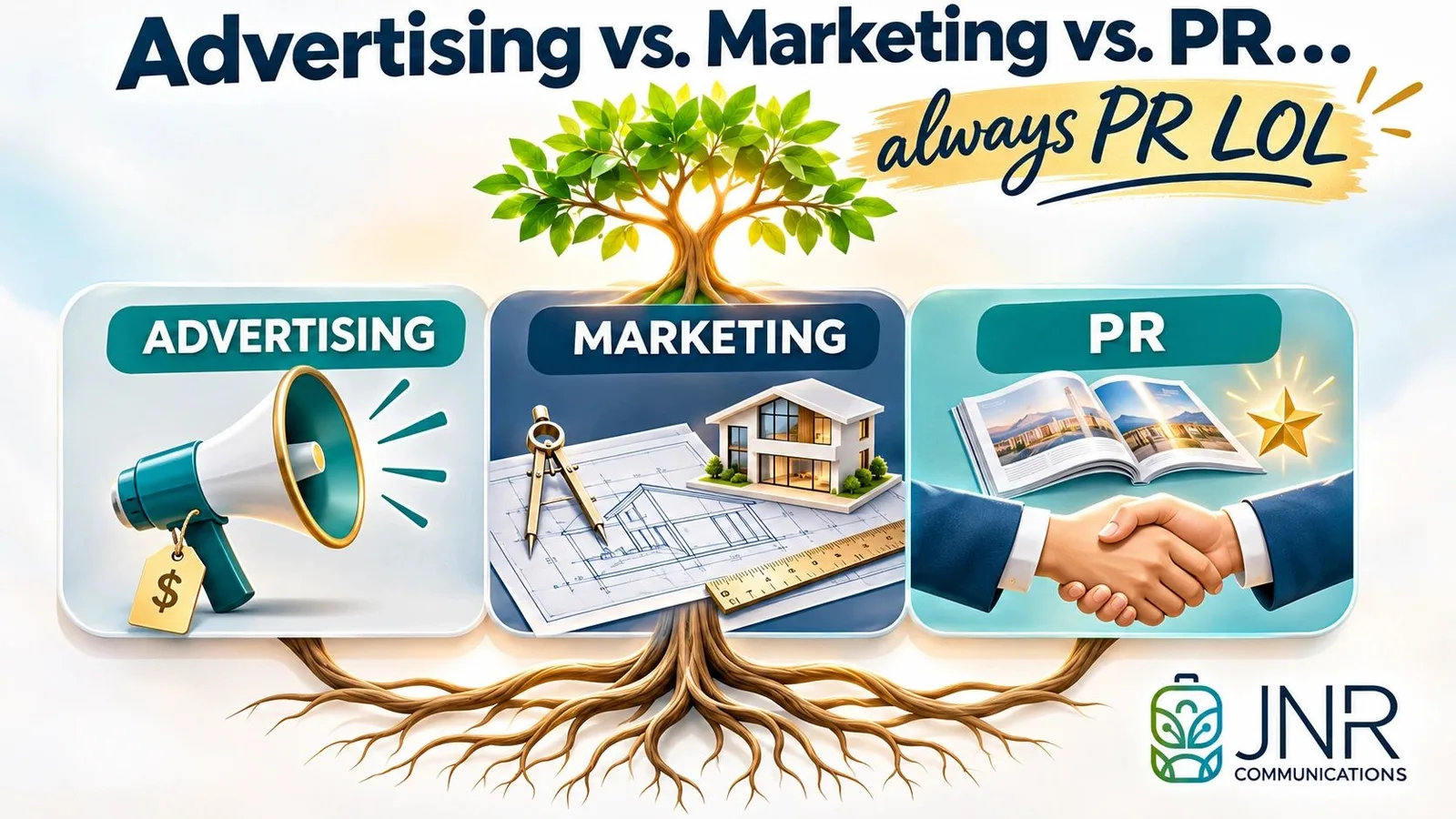
I think of integrated brand communications as a three-legged stool: marketing, advertising, and PR. Remove any one of those legs, and the whole thing wobbles.
Marketing tells your story consistently across owned channels, nurturing prospects through the funnel with content, email, and social engagement. Advertising amplifies that story at scale, placing your message in front of audiences you could not reach organically. PR builds the credibility layer underneath, earning third-party validation that makes both of the above more believable.
When the three are coordinated, you create what I like to call a surround-sound effect. A prospective client might see your Instagram content, then encounter your paid ad, then notice your founder quoted in a trade article, then finally receive a warm introduction from a referral partner. By the time they book a consultation, they have already convinced themselves. Your marketing did not have to work as hard because your PR had been working the whole time.
Here is a concrete example of how this plays out in aesthetics. A medspa launches a new body-contouring device. The marketing team builds educational content and email sequences. The ad team runs geo-targeted campaigns. In isolation, the conversions would come in steady but slow. Add a PR layer, a consumer magazine feature, a morning show demo, a quote from the lead provider in a trade publication, and the same ads suddenly feel familiar to the audience seeing them. Bookings lift. Cost per acquisition drops. Nothing in the media plan changed. The context around it did.
Where Marketing and PR Get Stuck
The failure mode I see most often is siloing. The marketing team is running its campaigns on its own calendar. The ad agency is optimizing its funnels. And PR, if it exists at all, is treated as something you layer on when you have budget left over.
That is backwards. In a well-run program, PR informs the marketing calendar and the advertising strategy, not the other way around. If we know we have a feature landing in a national magazine in March, the marketing team should be planning retargeting around that wave. The ad team should be briefed to lean into the credibility the coverage will create. The social team should be ready to amplify the moment it publishes.
This kind of coordination does not happen by accident. It requires someone holding the full picture, which is part of what a strategic PR partner brings to the table.
How JNR Communications Fits Into the Picture
At JNR Communications, we do not replace your marketing or advertising functions. We make them more effective.
Jennifer Rice, my partner at the agency, brings nearly three decades of editorial relationships with major media companies and the consumer and trade outlets that matter most in beauty, wellness, medical aesthetics, medical devices and consumer products. Those relationships are not theoretical. They are the reason we can place stories in rooms that cold pitches rarely reach. When an editor picks up a call from Jennifer, it is because she has spent decades earning that trust one story at a time.
My contribution to the partnership leans into the networking and relationship-building side. I spent years as a Ministry of Education Scholar at Nagoya University in Japan, where I learned the concept of nemawashi, the quiet groundwork of building consensus before any formal ask. That same philosophy shapes how I approach business development, social strategy, and referral relationships. It is the Givers Gain principle I live by: create value first, and opportunity follows.
For our clients, that combination plays out practically. We build media coverage that supports your advertising themes, not fights them. We develop thought leadership content that gives your founder a platform when your marketing team needs a credibility asset. We activate relationships in trade press, consumer media, and professional networks in ways that multiply whatever your in-house or agency partners are already doing. We work alongside your marketing team, not in competition with them.
Because we focus on medical aesthetics, beauty, wellness, and medical devices, we already know the editors, the regulatory nuances, the clinical language, and the competitive landscape. Your marketing team does not have to educate us. We come in with the context, and we add the layer of earned credibility that makes every other dollar you are spending work harder.
What You Can Do This Quarter
If you are reading this and recognizing your own situation, start here.
First, audit how aligned your PR, marketing, and advertising actually are. When was the last time the three functions sat in the same room to look at a single integrated calendar? If the answer is never, that is where to begin.
Second, map your upcoming marketing and advertising pushes against potential PR moments. Product launches, founder milestones, clinical data, award submissions, industry events. Every one of those is an opportunity to earn coverage that makes your paid media work harder.
Third, stop thinking of PR as a tactic you turn on when you need a quick win. It is infrastructure. Like any infrastructure, it compounds over time, and it supports everything built on top of it.
Let's Build Your Relationship Infrastructure
Marketing and advertising will always have a role. But the brands that break through add the credibility layer that PR provides, and coordinate all three disciplines around one strategic vision. At JNR Communications, we specialize in medical aesthetics, beauty, wellness, and medical devices, the categories where trust is not optional.
Email: Greg@JNRcommunications.com / Web: JNRcommunications.com