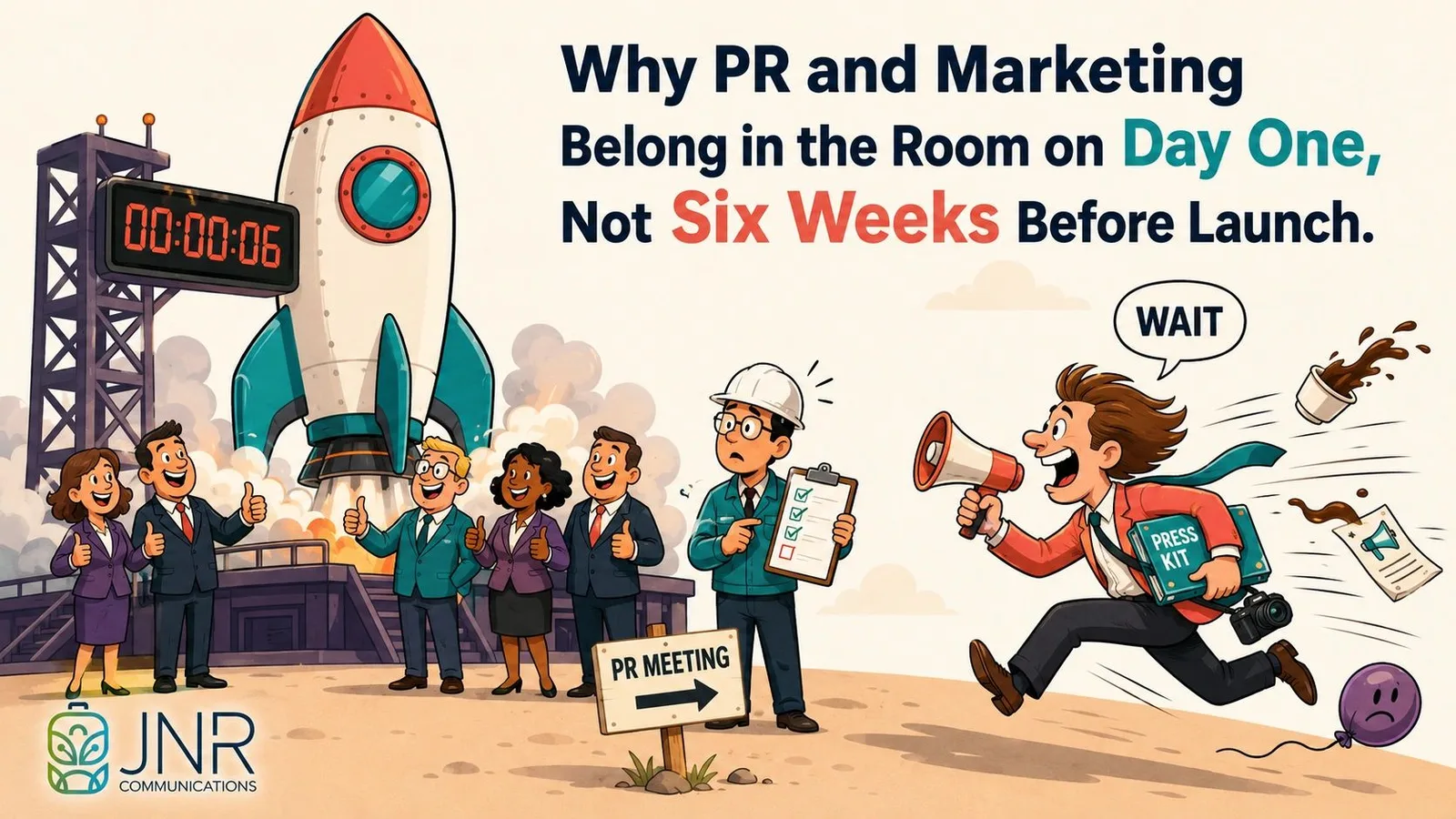
Bringing PR and marketing in late costs you the runway, the story, and the relationships. Here is what it actually costs, and how to fix it.
Years ago, in my healthcare technology days, I got a call about a hospital software rollout. Big system, thousands of clinicians, eight figures of investment, go-live in three weeks. They wanted me to build the training and adoption program.
Three weeks.
The software had been selected eighteen months earlier. The workflows had been designed without a single nurse in the room. The internal messaging had already gone out, and it had landed like an announcement rather than an invitation. By the time anyone thought to ask how people would actually be brought along, every decision that would determine whether they came along had already been made.
We did what we could. It worked, sort of. It cost roughly three times what it would have cost to do it right, and the adoption numbers never fully recovered.
I have watched the exact same movie play out in medical aesthetics, in beauty, in device launches, and in med spa openings. Different industry, identical plot. Somebody builds the thing, and then, near the end, somebody says: "We should probably tell people about this."
That sentence is where a lot of money quietly goes to die.
What "involved from the start" actually means
Let me be specific, because this phrase gets used loosely.
Involving PR and marketing from the start does not mean hiring an agency before you have a business. It means that at the moment you decide to build a thing, launch a location, add a service line, or bring a device to market, somebody in the room is responsible for the question: who needs to believe this, and what will make them believe it?
That person asks unglamorous questions early. What are we actually claiming, and can we prove it? Who is the customer, and where do they already go for trust? What will a journalist need from us, and when will they need it? Which relationships do we not have yet that we will desperately need in month nine?
Those questions are cheap to answer in month one. They are brutally expensive to answer in month eleven.
The five things you lose when you call late
1. You lose the media runway. This is the one that surprises people most. Monthly publications typically work three to six months ahead. A beauty editor planning holiday coverage is making decisions in early summer. So when you come to us six weeks before your launch and ask for national coverage timed to launch day, the honest answer is that the window closed a season ago. My partner Jennifer Rice has spent nearly thirty years building the relationships that get a client considered at all. What she cannot do, and what nobody can do, is move a print calendar backward.
2. You lose the story while you are living it. The best material in any launch happens during the build. The reason you started. The prototype that failed. The first patient who cried. The team photo at 11pm. Nobody documented any of it, because documenting it was not anyone's job yet. Six weeks out, we are reconstructing a story from memory instead of capturing one as it happened. You can always write copy later. You cannot go back and photograph a moment that already passed.
3. You lose the ability to change anything. Late-stage PR inherits every decision. The name is registered. The packaging is printed. The claim on the box has been through legal. If the positioning is confusing, or the name is impossible to search, or the claim cannot be substantiated well enough for a journalist to repeat it, we are not fixing that. We are marketing around it. Bringing communications in early is often less about promotion than about catching the expensive mistake while it is still a whiteboard.
4. You lose the deadlines you did not know existed. Award submissions close months ahead. Trade show press programs, media lists, and speaking slots fill early, and Las Vegas conference season does not wait for anyone. In my experience, these are the most painful losses because they are invisible until they are gone. Nobody sends you a reminder that you missed something you never knew about.
5. You lose the relationship runway, which is the one that really matters. Everything above is a calendar problem. This one is a trust problem, and trust does not compress. My years in Japan made this permanent for me. You do not walk into a relationship-based business culture cold and close on day one. You show up, you give first, you earn the right to ask. Givers Gain is not a nice sentiment, it is a scheduling reality. The referral partner who could send you thirty clients needs to know you before you need them. The journalist who covers your category needs to have received something useful from you before you show up asking for a favor. Start that in month one and you have an asset by launch. Start it six weeks out and you have a cold email.
The math nobody runs
Here is the part that gets skipped in budget meetings.
Late PR is not the same work compressed. It is different, worse work at a higher price. You end up buying reach you should have earned, because earned coverage takes lead time and paid coverage does not. You end up doing damage control on a positioning problem instead of preventing it. You end up running a launch with no third party validating you, which means the entire burden of persuasion falls on your own advertising, and we all discount advertising automatically.
The most expensive version of all of this is the quiet one. The launch does not fail. It just underperforms, permanently, and nobody ever traces it back to a decision made eleven months earlier about who was in the room.
What it looks like when it is done right
For a typical launch in beauty, wellness, or medical aesthetics, a sane timeline looks something like this.
Six months out: Positioning and proof. What are we claiming, what supports it, who is it for. Long-lead media planning begins. Relationship building starts with the referral partners, the peer practitioners, and the journalists who matter in your category. Award and trade show deadlines get mapped onto a calendar.
Three to four months out: Long-lead pitching. Assets get built while the story is still being made, not reconstructed after. Founder and executive visibility begins, so that by launch there is a credible human attached to the brand instead of a logo.
Six to eight weeks out: Short-lead and digital press. Local media. Influencer and partner coordination. Social content calendar built around the launch narrative rather than bolted onto it.
Launch: Everything fires at once because everything was set up in advance.
After: Sustained rhythm. The single biggest waste I see is treating a launch as an event rather than the start of a cadence.
If you are already late, do this today
Most people reading this have a project already in motion. So, practically:
Write down every date that is fixed and cannot move, then work backward from each one. You will immediately see which windows are still open.
Pick the one channel where your buyer already goes for trust, and go there first instead of trying to do all of them at half strength.
Start documenting now. Photos, quotes, the real reason you are doing this. You are collecting the raw material for the next nine months of content, and it is free.
Make a list of ten people whose recommendation would matter to your customer, and give each of them something of value in the next thirty days with no ask attached. That is your relationship infrastructure, and it starts paying in month three.
And for the next project, invite the communications people to the very first meeting. Not to present. Just to listen and ask questions. It is the cheapest insurance in your entire budget.
The bottom line
You cannot retrofit trust. You can retrofit a logo, a website, even a name if you must, but you cannot go back and build the relationships, capture the story, or reopen the calendar. PR and marketing are not the last step of a project. They are the part of the project that determines whether anyone finds out it happened.
The question I would leave you with is simple. On your next initiative, who in the room owns the question of who needs to believe this? If the answer is nobody yet, you have just found the cheapest fix available to you.
Planning something? Bring us in early. At JNR Communications, we combine Jennifer Rice's nearly 30 years of media relationships with my strategic networking expertise to help businesses in CPG brands, beauty, wellness, and medical aesthetics achieve visibility that generates real results. Let's build your relationship infrastructure together.
✉️ Greg@JNRcommunications.com / jnrcommunications.com