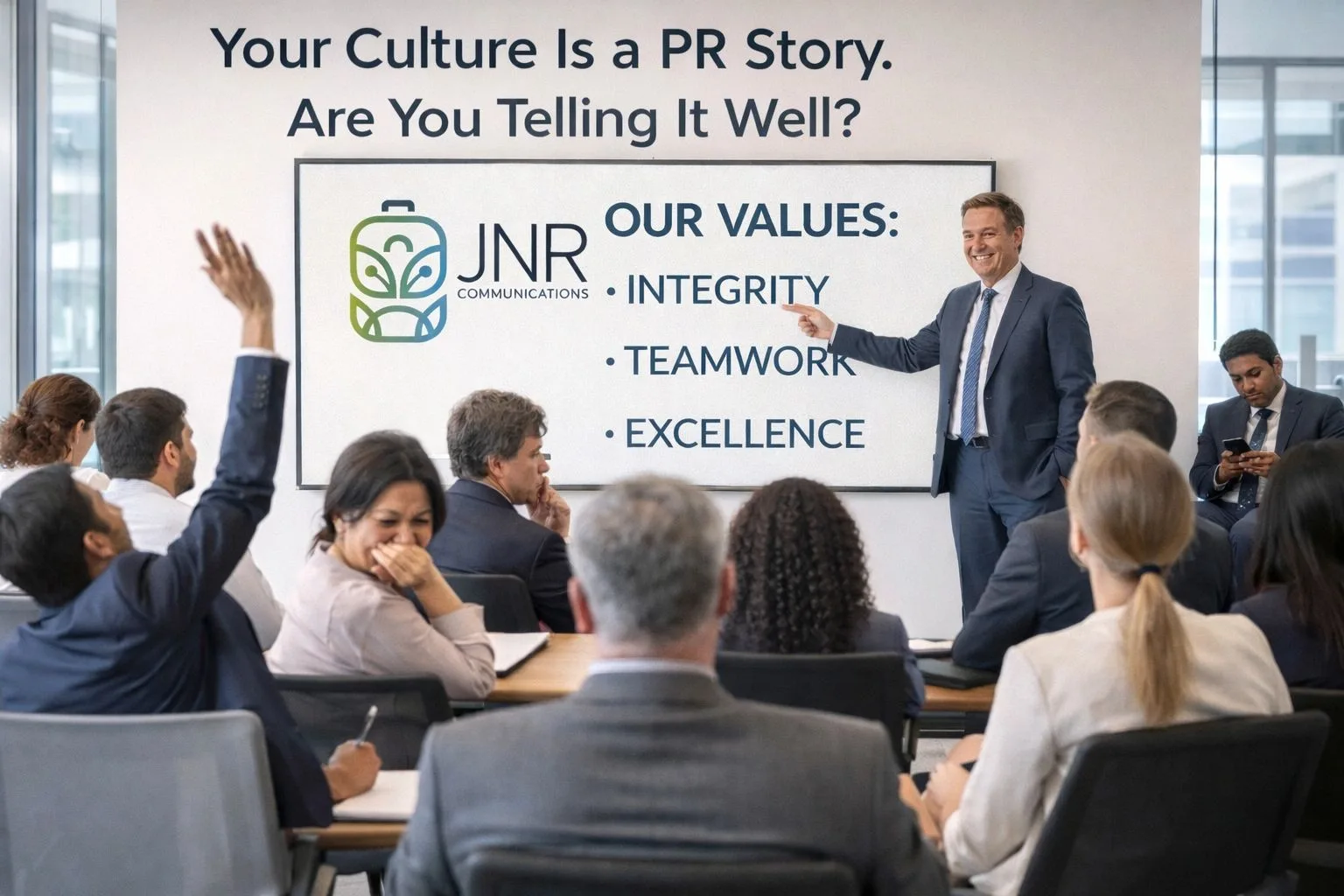
Here is something most executives do not hear often enough: your internal culture is not separate from your public reputation. It is the foundation of it.
I learned this lesson in a fairly unexpected place. During my years managing enterprise learning programs in healthcare technology, I watched organizations spend enormous resources on marketing and communications while the real story, the one being told by employees at dinner tables and on LinkedIn and in conversations with colleagues across the industry, was a completely different narrative. One they had no control over because they had never tried to shape it.
The companies that understood the connection between culture and reputation were the ones that attracted better talent, earned more media coverage, and recovered faster when something inevitably went sideways. The others were constantly playing catch-up, wondering why their carefully crafted press releases were not landing the way they expected.
The reason was simple: the outside story and the inside story did not match. Journalists know this. Prospective employees know this. Customers know this. And in the age of Glassdoor, LinkedIn, and instant online reviews, that gap is harder to hide than ever.
Culture Is Not a Background Detail. It Is a Lead Story.
Think about the brands you genuinely admire. The ones you trust. Chances are, when you scratch the surface, there is a coherent internal culture that shows up consistently in how they communicate, how they treat their people, and how they handle difficult moments.
That consistency is not an accident. It is the result of leaders who understand that what happens inside the organization becomes the raw material for everything that gets communicated outside of it.
In my experience working across industries from healthcare technology to international business development in Japan, I have found that the most credible companies share one trait: they are the same organization on the inside that they present themselves to be on the outside. Their values are not slogans on the wall. They are visible in decisions, in how conflict gets resolved, in how leadership communicates during hard times.
That alignment is your most powerful PR asset. And most organizations are not intentionally building it.
The Ways Culture Leaks Into Your Public Reputation
You may not be issuing press releases about your internal operations. But your culture is being communicated constantly, through channels you may not have considered:
• Employee reviews on Glassdoor and Indeed shape how job seekers, journalists, and potential clients perceive your organization before they ever reach out.
• LinkedIn activity by your team members, what they share, how they talk about their work, whether they engage with company content, signals the health of your culture publicly.
• How your leadership communicates during difficult moments, layoffs, policy changes, industry shifts, tells a story about your values in ways that formal communications never can.
• Word-of-mouth in your industry travels faster than any press release. The way your team talks about your company in professional circles shapes your reputation among the people whose opinions matter most.
• Media coverage often reflects internal realities. Journalists who cover your industry are talking to people. Consistently high-performing companies with strong cultures attract positive coverage for a reason.
What does your culture look like from the outside?
If you searched your company name today alongside the words "employees" or "team" or "culture," what story would you find? That story exists whether you are telling it or not. The question is whether you want a hand in shaping it.
Organizational Change and the PR Implications
This is where my background in organizational change management becomes directly relevant to PR strategy. When companies go through transitions, restructuring, leadership changes, rapid growth, new technology implementations, the internal experience of that change does not stay internal for long.
I spent years helping organizations design learning programs and manage the human side of enterprise change. The consistent finding was that organizations that communicated transparently, acknowledged difficulty, and reinforced values throughout a transition came out with their culture intact. The ones that tried to manage the optics without managing the reality ended up with both a cultural problem and a reputation problem.
A business going through a merger, for example, that communicates clearly with its team, maintains its commitments to employees, and handles the transition with integrity generates a very different kind of press than one that does not. Sometimes that press is formal media coverage. Often it is the informal but equally powerful word-of-mouth that shapes how the industry perceives you.
The principle holds across industries. Whether you are a growing medspa navigating rapid expansion, a medical device company managing a product pivot, or a wellness brand scaling your team, how you handle internal moments of change becomes part of your external story.
Values as a Communications Strategy
I want to challenge a framing that comes up a lot in business communications: the idea that values are something you state and then separately enact. The most effective PR strategies I have seen treat values not as background context but as active content.
When a company makes a difficult decision and can articulate clearly why that decision reflects its core commitments, that is a communications asset. When leadership responds to a team challenge with transparency and respect, that is a story worth telling. When a company genuinely lives out the values it espouses, the communications almost write themselves.
This does not mean broadcasting every internal decision. It means developing the discipline to connect external communications to authentic internal realities. That connection is what makes PR resonate rather than ring hollow.
In Japan, where I spent several years doing research and teaching at Nagoya University, I encountered business cultures where the concept of organizational identity was inseparable from external reputation. The internal and external were understood to be one continuous reality, not separate functions to manage independently. That perspective shaped how I think about communications work, and it is something I bring to every client relationship at JNR.
When Culture Problems Become PR Crises
Let me be direct about something. The reverse of everything I have described is also true. Organizations that allow toxic cultures to persist, that tolerate poor communication, that handle conflict badly or dismiss employee concerns, are building the conditions for a future PR problem.
I have watched it happen. A pattern of internal mismanagement surfaces publicly. A disgruntled former employee speaks to a journalist. A team's frustration spills onto social media. A pattern of behavior that leadership thought was contained turns out to have been widely known throughout the industry all along.
The best crisis prevention strategy is a strong internal culture. Not because good culture makes you immune to problems, but because organizations with genuine values and strong communication habits know how to address problems before they become crises, and how to respond with credibility when challenges do arise.
This is one of the most consistent things I have seen across my experience in healthcare technology and business development: organizations that invest in culture invest in resilience. And resilience is what PR is ultimately in service of.
What JNR Communications Does With This
At JNR Communications, we work with clients in medical aesthetics, beauty, wellness, and medical device industries where trust is the foundation of every client relationship. In these fields, reputation is not abstract. It directly affects revenue, patient or client acquisition, and the ability to attract the partners and media relationships that drive growth.
Our approach to PR recognizes that the most effective external communications are grounded in authentic internal realities. Jennifer Rice has spent nearly 30 years building media relationships with major outlets and what she will tell you is that those relationships are built on credibility. Credibility that comes from representing clients whose story is consistent and real.
When we work with a client, we are not just asking about their media goals. We are asking about their culture, their values, how they handle conflict, how their team talks about them. Because that is the raw material of PR that actually works.
We help clients identify the authentic culture stories worth telling. We help them develop communications approaches that reflect genuine values rather than aspirational language. And we connect those internal realities to the external coverage, social presence, and industry reputation that drives business growth.
Your culture is already telling a story.
We help make sure it is the right one. At JNR Communications, we bring nearly 30 years of media relationships and deep expertise in the beauty, wellness, and medical aesthetics industries to help businesses build the reputation infrastructure that real growth requires.
Let us talk about your goals.
Greg@JNRcommunications.com | JNRcommunications.com