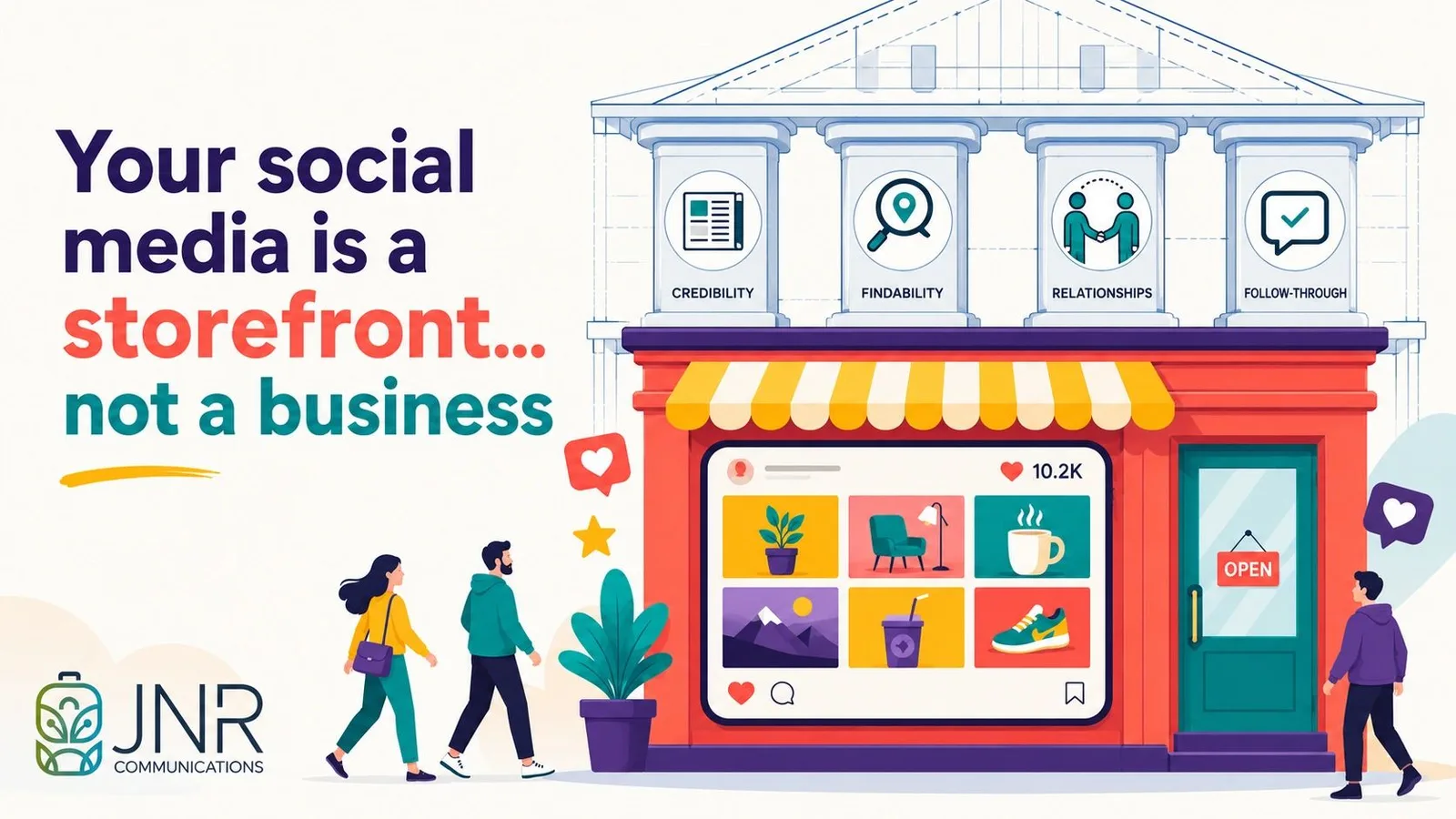
Your social media proves you exist. It does not prove you are trusted, findable, or referred. Here are the four layers brands actually grow on.
A few years back I walked past a boutique in a beautiful building on a street almost nobody drove down. The window display was gorgeous. Perfect lighting, thoughtful styling, clearly the work of someone with real taste and real care. I remember thinking that whoever owned that shop knew exactly what they were doing.
They closed within the year.
Not because the storefront was bad. Because a storefront is not a business. It is one visible piece of a business, and it only works when everything behind it, and around it, is working too.
I think about that shop constantly now, because it is the most honest description I have found for what happens to a lot of brands on social media. The grid is beautiful. The reels are well edited. The captions are thoughtful. And the phone still is not ringing the way it should.
If that is you, I want to be clear about something up front. The problem is usually not your content. The problem is that you have built a storefront and are waiting for it to behave like a business.
What your storefront is genuinely good at
Let me defend social media before I complain about it, because I am not in the camp that says it does not matter. It matters enormously. It just has a job description, and the job description is narrower than most people think.
Your social presence proves you exist. In 2026, a business with no visible feed reads as either brand new or quietly out of business. Fair or not, that is the reflex.
It proves taste and competence. In medical aesthetics, beauty, and wellness especially, people are evaluating your eye, your standards, and your results. A well-run feed answers questions a website never will.
It gives people something to look at while they decide. Almost nobody chooses you on the feed. But almost everybody checks the feed on the way to choosing you. That is not a small role.
And it gives you a place to be human, consistently, in front of people who are not ready to buy yet. That is real relationship work.
So keep the storefront. Make it beautiful. Just stop expecting it to do the other four jobs.
The four jobs your feed cannot do
Here is where I see good businesses lose momentum, and it is almost never for lack of effort.
Your feed cannot vouch for you. Everything on it is something you said about yourself. We are all wired to discount that. It is why an ad that says "the best in Las Vegas" gets mentally filed under "of course they would say that," while a mention in a publication a reader already trusts lands completely differently. Credibility, by definition, has to come from somewhere other than you.
Your feed cannot be found by people who are not looking for you. Social media serves you to people who already follow you, or to people the algorithm decides to show you to that day. Search is different. When somebody types "best dermatologist near me" or "is this treatment safe," they are raising their hand as a buyer. If nothing about you shows up in that moment, you were not in the running.
Your feed cannot introduce you. The highest-value client in specialized industries usually arrives by referral, often from another professional. The plastic surgeon who sends patients to a med spa for post-procedure care. The wellness practitioner who has a trusted injector. Those relationships are built in rooms, on calls, and over time. No amount of posting builds them for you.
Your feed cannot survive a decision it does not control. Every follower you have lives on land you rent. The platform changes what it rewards, and reach you spent three years building can drop by half in a month without anyone telling you. I do not say that to be alarming. I say it because it is a reason to build assets you own alongside the ones you rent.
What actually holds a brand up
In my healthcare technology years, I designed and ran training programs for enterprise software rollouts. Big systems, thousands of clinicians, high stakes. The single most consistent lesson from that work was this: awareness is the easy part.
We could get every nurse in a hospital to know the new system existed. Getting them to trust it, adopt it, and stay with it required repeated exposure through channels they already believed in. Their charge nurse. A colleague who tried it first. A supervisor who used it in front of them. Announcements alone never moved anyone.
Brand growth works the same way, and it runs on four layers underneath the storefront.
The credibility layer. Third-party validation. Earned media, expert commentary, awards, being quoted as the person who knows. One strong placement keeps working for years. It shows up in search, gets linked to, gets cited in your bio, and quietly reassures the skeptical high-value client who researches before they buy. My partner Jennifer Rice does not land those placements with one clever email. She lands them on nearly thirty years of relationships with journalists who already trust her to deliver a credible source on deadline. That trust was built long before it was needed, which is the only way it ever gets built.
The findability layer. Your website, your Google Business Profile, your reviews, the way your name looks on page one of a search. This is the least glamorous work in marketing and the highest-converting. Somebody who searched for you is much further along than somebody who scrolled past you.
The relationship layer. Referral partners, peers, adjacent professionals, past clients who advocate for you. In networking we call the operating principle Givers Gain, and it is the closest thing to a guaranteed strategy I know. Give value first, with no immediate agenda, consistently. My years in Japan taught me the patience version of this: you do not walk in cold and close on day one. The business follows the relationship, never the other way around.
The follow-through layer. What happens after someone raises their hand. How fast you respond. What the intake call feels like. Whether the experience matches the promise the storefront made. I have watched businesses spend a fortune on visibility while quietly losing people at the fourth layer, and they always blame the first one.
A brand that grows has all five working together. A brand that stalls usually has one gorgeous layer and four thin ones.
Try this exercise this week
Because I would rather give you something to do than something to think about, here is a diagnostic that takes about thirty minutes.
Open a private browser window and search your business name. Read the entire first page the way a stranger would, not the way an owner would. What does the internet say about you when you are not the one talking? For most businesses, the honest answer is "not much," and that gap is the whole opportunity.
Then answer four questions with a yes or a no.
If someone hears about you from a friend and looks you up, do they find something credible that you did not write about yourself?
If someone searches your service and your city, do you appear at all?
Can you name five professionals who could send you business, and did you give any of them something of value in the past ninety days?
If a stranger messages you today, how many hours pass before a real person responds?
Whichever answer made you uncomfortable is your next project. Not more posting.
The honest bottom line
Social media is a networking tool and a storefront, and it is worth doing well. But a business that grows is not the one with the best window display. It is the one with credibility behind it, findability around it, relationships feeding it, and follow-through that keeps the promise.
Here is the question I would leave you with. If you disappeared from social media for the next ninety days, what in your business would still bring people to your door? Whatever you just answered is the durable part of your brand. That is the part worth growing.
The good news is that none of this requires a rebrand or a bigger budget. It requires deciding that the storefront was never supposed to carry the whole thing, and starting on the layer you have been avoiding.
Ready to build the layers underneath the storefront? At JNR Communications, we combine Jennifer Rice's nearly 30 years of media relationships with my strategic networking expertise to help businesses in CPG brands, beauty, wellness, and medical aesthetics achieve visibility that generates real results. Let's build your relationship infrastructure together.
📞 (818) 357-7286 | ✉️ Greg@JNRcommunications.com